SMAS Accreditation Requirements for Contractors
For contractors working in the UK construction industry, demonstrating effective health and safety management is increasingly important. Clients and principal contractors want evidence that businesses understand their responsibilities, manage workplace risks, and have appropriate systems in place before allowing them onto a project. This is why understanding SMAS Accreditation Requirements is important for contractors of all sizes.
SMAS is a recognized health and safety assessment scheme and a member of the Safety Schemes in Procurement (SSIP) framework. The assessment helps demonstrate that a contractor has suitable arrangements for managing health and safety within its business. For a contractor, achieving accreditation is not simply about completing an application form. You need to provide appropriate evidence showing how your business manages health and safety in practice.
This can include your health and safety policy, risk assessments, method statements, training records, insurance information, accident procedures, and other relevant documentation. The requirements can appear complicated if you have never completed a health and safety assessment before. However, with good preparation, most businesses can organize their information and approach the process with confidence. This guide explains the main SMAS Accreditation Requirements for contractors, the documents you may need, common problems to avoid, and practical steps you can take before submitting your application.
Understanding the SMAS Accreditation Requirements early can help contractors identify missing documentation and prepare their business before beginning the assessment.
What Is SMAS Accreditation?
SMAS Accreditation is a recognized assessment of a contractor’s health and safety management arrangements. SMAS stands for Safety Management Advisory Services. It operates within the wider SSIP framework, which aims to improve consistency and reduce unnecessary duplication in health and safety assessments for contractors and suppliers.
You can learn more about the scheme through the official SMAS website: https://www.smasltd.com/
The SSIP framework can also be found at: https://www.ssip.org.uk/
During the assessment, contractors are expected to provide evidence that they have suitable health and safety systems relevant to their business activities.
The assessment may consider areas such as the following:
- Health and safety policies
- Risk assessment procedures
- Method statements
- Employee competence
- Training arrangements
- Insurance
- Accident management
- Management responsibilities
- Workplace safety procedures
The exact evidence required can depend on the nature and size of your business.
Why Do Contractors Need to Meet SMAS Accreditation Requirements?
Health and safety accreditation can be important when working with larger organizations. Many principal contractors, commercial clients, housing associations, local authorities, and other organizations use contractor accreditation as part of their procurement process. Having recognized accreditation can help demonstrate that your business has already undergone an independent assessment.
For contractors, this can provide several advantages:
- Greater client confidence
- Improved professional credibility
- Access to additional tender opportunities
- Better preparation for procurement checks
- Stronger internal health and safety systems
- Reduced duplication during contractor assessments
It is important to remember that accreditation does not guarantee that you will win a contract. However, it can help you satisfy a requirement that may otherwise prevent you from being considered for certain projects.
Who Can Apply for SMAS Accreditation?
SMAS Accreditation is not limited to large construction companies. Businesses of different sizes can apply, including sole traders and small contractors, provided they can demonstrate suitable health and safety arrangements.
Typical applicants include the following:
- General building contractors
- Civil engineering companies
- Groundworkers
- Electrical contractors
- Mechanical contractors
- Plumbing businesses
- Roofing contractors
- Property maintenance companies
- Facilities management businesses
- Landscaping contractors
- Specialist subcontractors
- Engineering companies
The important point is that your documentation should reflect the actual work your organization carries out. A small roofing contractor will have different risks and procedures from a large civil engineering company. Your application should therefore be proportionate to your activities.
Main SMAS Accreditation Requirements
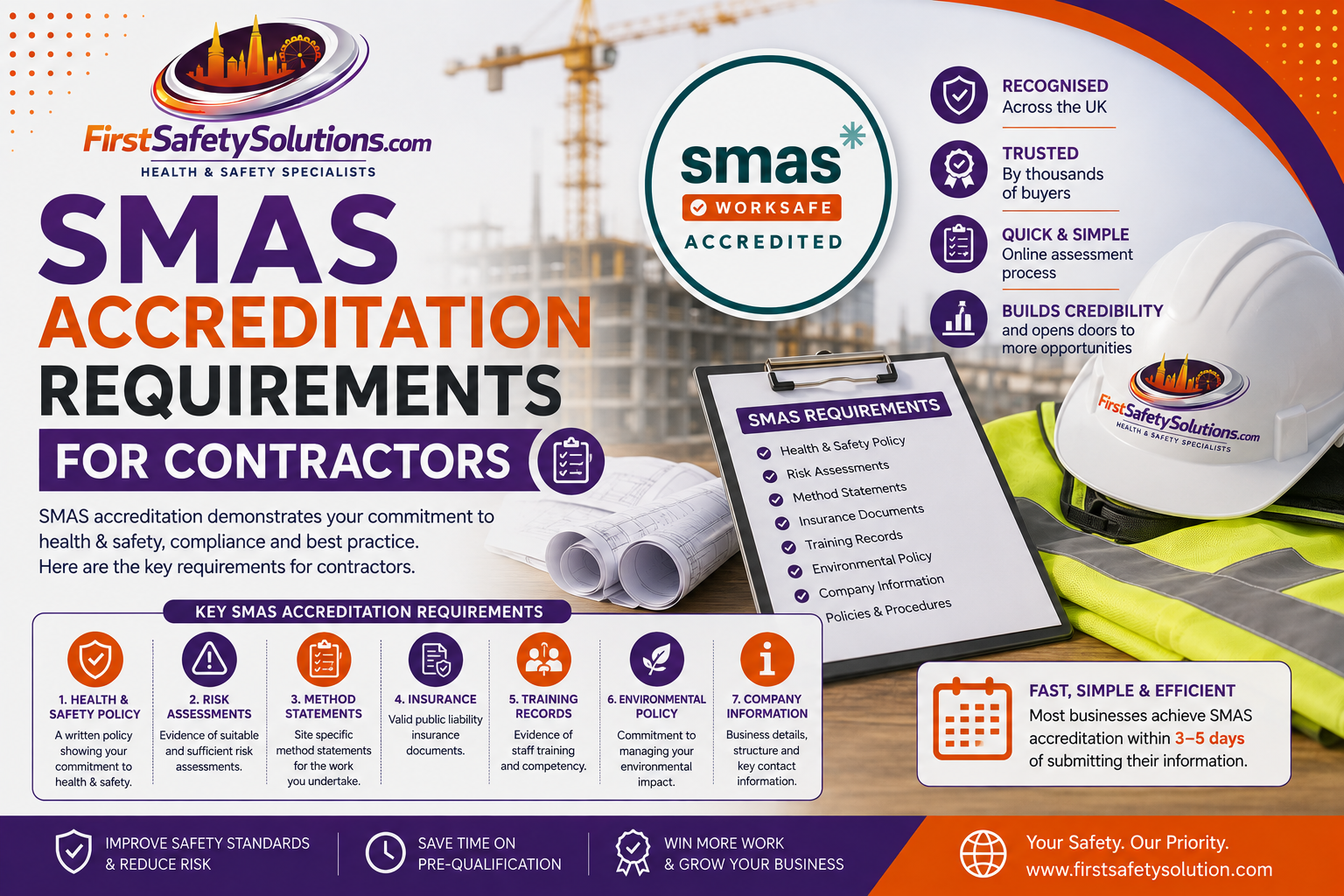
The exact assessment requirements depend on your business, but several areas are particularly important for most contractors. Before applying, review your documentation and make sure you can provide suitable evidence for the following areas:
| Requirement | What It Demonstrates |
|---|---|
| Health and safety policy | Management commitment to safety |
| Risk assessments | Identification and control of workplace hazards |
| Method statements | Safe planning of work activities |
| Training records | Workforce competence |
| Insurance | Appropriate business protection |
| Accident procedures | Effective incident management |
| Management responsibilities | Clear allocation of safety duties |
| Monitoring arrangements | Ongoing health and safety control |
Preparing these areas before applying can make the assessment considerably easier.
Health and Safety Policy Requirements
A current health and safety policy is one of the most important documents for a contractor. The policy should explain how your organization manages health and safety and who is responsible for implementing the arrangements.
A suitable policy will generally cover three important areas:
Statement of Intent
This section explains the company’s commitment to protecting employees and others who may be affected by its activities. It should demonstrate that senior management takes health and safety seriously.
Responsibilities
The policy should explain who is responsible for different health and safety duties.
Depending on your business, this could include the following:
- Managing director
- Health and safety manager
- Site manager
- Supervisors
- Employees
- Subcontractors
Responsibilities should be realistic and reflect the actual structure of your organization.
Arrangements
This section explains how your company manages health and safety in practice.
It may cover:
- Risk assessments
- Training
- Consultation
- Emergency arrangements
- PPE
- Accident reporting
- Site inspections
- Monitoring
A policy should not simply be copied from a generic template. It should reflect your actual business operations. Meeting the SMAS Accreditation Requirements starts with having a current health and safety policy that reflects the company’s actual activities and responsibilities.
Risk Assessment Requirements
Risk assessments are another important part of SMAS Accreditation Requirements. A risk assessment identifies hazards associated with your work and explains the measures used to control those risks. Your assessments should be suitable and sufficient for the activities you undertake. Risk assessments are another important part of the SMAS Accreditation Requirements because they demonstrate how contractors identify and control workplace hazards.
Depending on your business, relevant assessments may cover:
- Working at height
- Manual handling
- Electrical hazards
- Excavation
- Machinery
- Hazardous substances
- Noise
- Dust
- Fire
- Slips and trips
- Vehicle movements
- Site access
What Should a Risk Assessment Include?
A practical risk assessment should generally identify the following:
- The activity being assessed
- Potential hazards
- People who could be harmed
- Existing control measures
- Further action required
- Responsible persons
- Review arrangements
The document should be understandable to the people who actually carry out the work.
Method Statement Requirements
Method statements explain how a particular activity will be completed safely. They are especially important for construction work where activities may involve significant risks.
A method statement may include:
- Description of the work
- Sequence of activities
- Equipment required
- Competency requirements
- PPE
- Risk controls
- Site arrangements
- Emergency procedures
The method statement should correspond with the relevant risk assessment. For example, if your company carries out roof work, your documentation should clearly explain how workers will access the roof, prevent falls, use equipment safely, and respond to emergencies.
Training and Competence Requirements
Contractors must be able to demonstrate that employees are competent to perform their assigned duties safely. This does not necessarily mean every employee needs the same qualifications. Training should be appropriate to the person’s role and responsibilities. Employee competence is also considered when contractors prepare for the SMAS Accreditation Requirements.
Evidence may include:
- Training certificates
- Qualification records
- Induction records
- Toolbox talks
- Competency assessments
- Refresher training
- Plant operator qualifications
For construction businesses, relevant training may include working at height, manual handling, asbestos awareness, first aid, plant operation, or other role-specific subjects.
Insurance Requirements
Suitable insurance is another important area contractors should prepare before applying. Contractors should also check their insurance documentation against the SMAS Accreditation Requirements before submitting an application.
Depending on your circumstances, you may need evidence of:
- Employer’s Liability Insurance
- Public Liability Insurance
- Professional Indemnity Insurance
Insurance requirements can differ according to the nature of your work and whether you employ staff. Make sure certificates are current and clearly show the business name. An expired certificate or mismatch between the certificate and company details can create unnecessary problems during an assessment.
Accident and Incident Reporting Requirements
Contractors should have a clear procedure for dealing with accidents, incidents, and near misses.
Your arrangements should explain how incidents are:
- Reported
- Recorded
- Investigated
- Reviewed
- Followed up
A good accident management process should not simply record what happened. It should also identify why the incident occurred and whether corrective action is needed.
Evidence may include:
- Accident forms
- Investigation reports
- Corrective action records
- Near-miss records
- RIDDOR procedures where applicable
Emergency Procedure Requirements
Your organization should have suitable emergency arrangements based on its activities.
Depending on the type of work you undertake, procedures may cover:
- Fire
- Serious injury
- Chemical spills
- Electrical incidents
- Evacuation
- Severe weather
- Site emergencies
Employees should understand what to do during an emergency and who is responsible for managing the response.
PPE and Safe Working Requirements
Where personal protective equipment is necessary, contractors should have appropriate arrangements for selecting, providing, maintaining, and using PPE.
Depending on the work, this might include the following:
- Safety footwear
- Hard hats
- Gloves
- Eye protection
- Hearing protection
- High-visibility clothing
- Respiratory protection
- Fall protection equipment
PPE should not be treated as the only safety measure. Businesses should consider suitable control measures through the hierarchy of controls and use PPE where appropriate.
Monitoring and Review Requirements
Health and safety systems should not be left untouched after accreditation. Contractors should regularly monitor whether their procedures remain effective.
Useful monitoring activities can include:
- Workplace inspections
- Site audits
- Management reviews
- Toolbox talks
- Incident reviews
- Risk assessment reviews
- Employee consultation
Regular monitoring provides evidence that health and safety is actively managed rather than simply documented for an accreditation application.
Environmental and Quality Considerations
Although health and safety is central to the assessment, contractors may also need to demonstrate that they have suitable systems for other areas of business management depending on the requirements being assessed.
This may include:
- Environmental management
- Waste procedures
- Quality control
- Equality and diversity
- Supply chain management
Having organized policies in these areas can also strengthen your overall procurement profile.
SMAS Accreditation Requirements Checklist
Before submitting your application, use this checklist to review the main areas of your health and safety management system. Reviewing the following areas can help you determine whether your business is ready to meet the SMAS Accreditation Requirements.
| Area | Ready? |
| Current health and safety policy | ✓ |
| Relevant risk assessments | ✓ |
| Suitable method statements | ✓ |
| Current insurance certificates | ✓ |
| Employee training records | ✓ |
| Competency information | ✓ |
| Accident reporting arrangements | ✓ |
| Emergency procedures | ✓ |
| PPE arrangements | ✓ |
| Monitoring and inspection records | ✓ |
| Management responsibilities | ✓ |
| Policies reviewed and updated | ✓ |
This checklist is a practical starting point, but individual requirements can vary depending on your organization and the work you undertake.
How to Prepare Before Applying
The best time to identify gaps in your documentation is before submitting the application. Start by gathering all existing health and safety documents into one place. Review each document carefully and check whether it reflects your current business.
Ask yourself:
- Does our health and safety policy reflect our current activities?
- Are our risk assessments relevant to the work we currently undertake?
- Are our method statements up to date?
- Do employee training records show current competence?
- Are our insurance certificates valid?
- Do we have a clear accident reporting procedure?
- Have we reviewed our emergency arrangements?
- Are responsibilities clearly allocated?
If the answer to any of these questions is no, address the issue before submitting your application. Good preparation can reduce delays and make the process much more straightforward.
Why Tailored Documentation Matters
One of the most common mistakes contractors make is relying too heavily on generic templates. A template can provide a starting structure, but your final documents should reflect your business. For example, a contractor carrying out electrical installations has different risks from a company specializing in landscaping.
Your documentation should therefore explain:
- What your business does
- Where work takes place
- Who carries out the work
- What hazards exist
- How risks are controlled
- Who is responsible for safety
Tailored documentation provides stronger evidence that your health and safety arrangements are genuinely implemented.
What Happens If Your Documentation Is Incomplete?
An incomplete application does not necessarily mean that your business cannot achieve accreditation. However, missing or unsuitable information can lead to requests for clarification or additional evidence.
This may cause:
- Delays
- Additional administration
- More document preparation
- Repeated reviews
- Increased pressure on management
For this reason, contractors should avoid rushing the application. Taking time to prepare properly can save considerable effort later.
Professional Support With SMAS Accreditation Requirements
Some contractors have strong practical experience but lack the time or specialist knowledge needed to review all their compliance documentation. Professional health and safety support can be useful in these circumstances. First Safety Solution can help businesses review their existing arrangements, identify documentation gaps, and prepare for accreditation. If you are unsure whether your documentation meets the SMAS Accreditation Requirements, professional guidance can help identify areas that need improvement.
Support can include:
- Health and safety policy reviews
- Risk assessment preparation
- Method statement support
- Compliance documentation reviews
- Training and competency guidance
- Accreditation application support
- General health and safety consultancy
You can explore the available accreditation services here: https://firstsafetysolution.com/accreditation/
For specific SMAS support: https://firstsafetysolution.com/accreditation/ssip-smas/
If you are also considering CHAS, you can find information about that accreditation here: https://firstsafetysolution.com/accreditation/chas-accreditation-uk/
Frequently Asked Questions
What are the main SMAS Accreditation Requirements?
The main requirements generally include a suitable health and safety policy, relevant risk assessments, method statements, training and competency records, insurance information, accident procedures, and evidence of appropriate health and safety management.
Do sole traders need to meet SMAS Accreditation Requirements?
Yes. Sole traders can apply for accreditation, although their documentation should be proportionate to the work they undertake and the risks associated with their activities.
Do small contractors need a health and safety policy?
Businesses should have appropriate health and safety arrangements, and where the law requires a written policy, it should be maintained and communicated appropriately. Contractors should make sure their documentation reflects their actual responsibilities and working practices.
Are risk assessments required for SMAS Accreditation?
Risk assessments are an important part of demonstrating how workplace hazards are identified and controlled. The assessments should be relevant to the work your business carries out.
Do I need method statements?
Where your work requires safe systems of work or specific activity planning, method statements can provide important evidence of how risks will be controlled.
What training records should contractors keep?
Training records should demonstrate that workers have the knowledge, skills, training, and experience required for their roles. The exact training needed depends on the activities being undertaken.
Can First Safety Solution help prepare my documents?
Yes. First Safety Solution can support contractors with health and safety documentation, policies, risk assessments, method statements, compliance reviews, and accreditation preparation.
Is SMAS Accreditation a legal requirement?
SMAS Accreditation itself is not a legal requirement for every contractor. However, individual clients or procurement organisations may require contractors to hold recognised accreditation before they can tender for or undertake certain work.
Conclusion
Understanding SMAS Accreditation Requirements before applying can make the entire process easier and more efficient. Contractors need to demonstrate that their health and safety arrangements are appropriate for their business activities and that risks are being managed effectively. The most important areas to prepare include your health and safety policy, risk assessments, method statements, insurance, employee competency records, accident procedures, emergency arrangements, and ongoing monitoring systems.
Good documentation is important, but businesses should remember that health and safety is about more than paperwork. Policies and procedures should reflect what actually happens in the workplace and should be communicated to the people responsible for carrying out the work. For contractors preparing for accreditation, the best approach is to start early. Review your existing documents, identify gaps, update outdated information, and make sure your procedures are suitable for your current activities.
If you are unsure whether your business meets the SMAS Accreditation Requirements, professional support can help you identify areas for improvement and prepare your documentation with greater confidence. First Safety Solution can assist contractors with health and safety documentation, compliance reviews, risk assessments, policies, and accreditation preparation, helping businesses work towards recognised health and safety standards efficiently. By preparing the SMAS Accreditation Requirements in advance, contractors can approach the assessment with better organisation and confidence.