How Long Does SMAS Accreditation Take?
For UK contractors, getting health and safety accreditation can be an important step towards meeting client requirements and demonstrating that the business takes workplace safety seriously. However, one of the first questions many contractors ask is simple: how long will the application actually take?
The answer depends on how prepared your business is, how quickly you provide the required information, and whether the assessor needs additional evidence or clarification. The SMAS Accreditation Process is designed to assess a contractor’s health and safety arrangements against recognized criteria. SMAS Worksafe is an SSIP member scheme, and its assessment is carried out against the SSIP Core Criteria. The assessment is proportionate to the nature of the work and size of the organization.
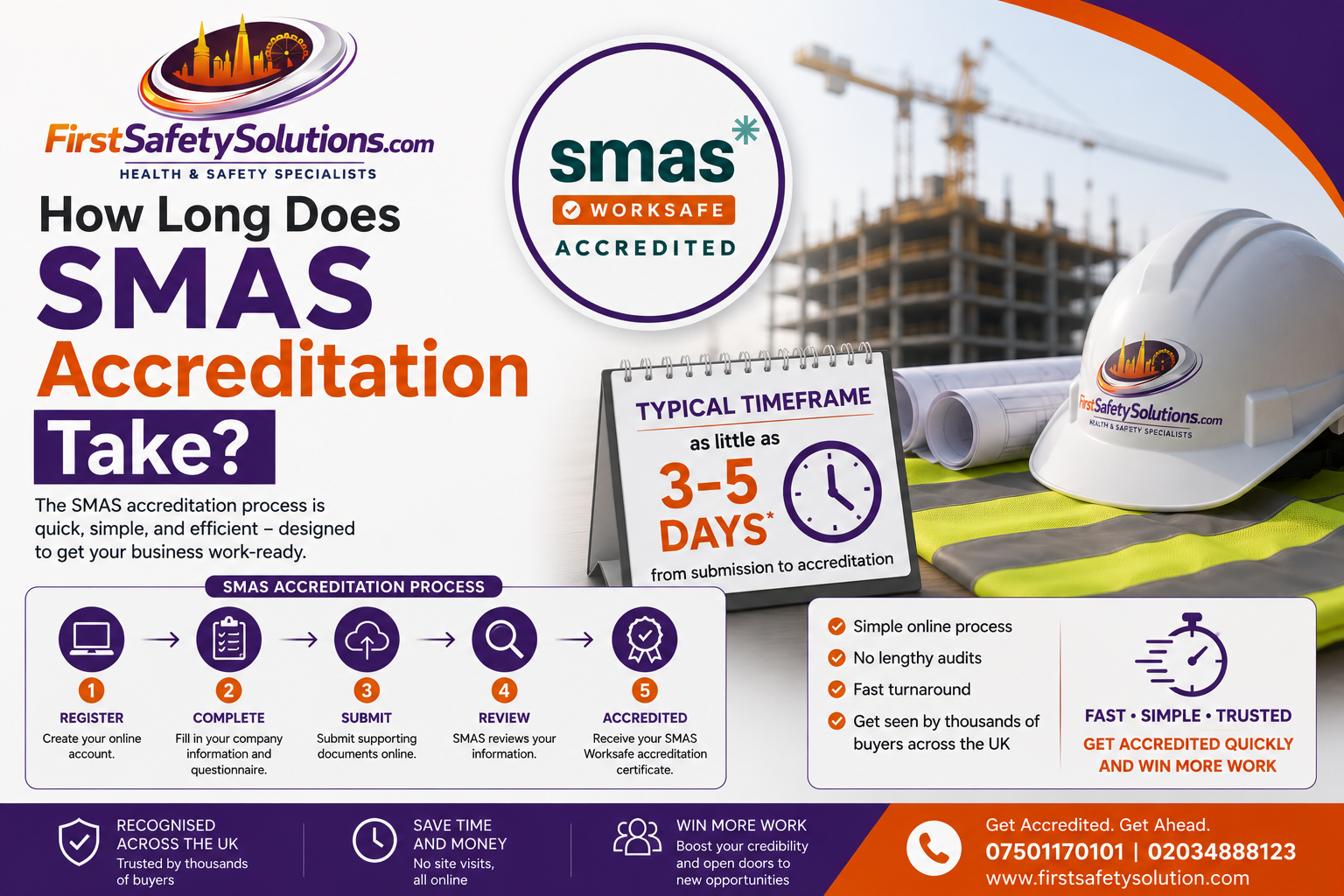
According to the official SSIP guidance, assessment times vary between schemes and depend on the supplier providing everything required. SSIP says schemes typically aim to complete an initial assessment within ten working days. That does not mean every application will take exactly ten working days. A well-prepared contractor may move through the process more smoothly, while incomplete documentation or additional questions can extend the overall timeframe.
This guide explains the different stages of the SMAS Accreditation Process, what can cause delays, how to prepare your documents, and what contractors can do to make the application as straightforward as possible.
What Is the SMAS Accreditation Process?
The SMAS Accreditation Process involves reviewing a contractor’s health and safety management arrangements to determine whether they meet the required assessment standard. SMAS Worksafe is a registered SSIP member scheme. The SSIP Forum confirms that SMAS Worksafe carries out a desktop assessment against the SSIP Core Criteria for relevant categories, including contractor and principal contractor roles.
You can learn more about the official framework through: SSIP – Safety Schemes in Procurement
The assessment can consider areas such as:
- Health and safety policy
- Competent health and safety advice
- Training arrangements
- Risk assessments
- Safe systems of work
- Monitoring and review
- Accident reporting
- Workforce involvement
- Subcontracting arrangements
- Welfare provisions
- Cooperation with other duty holders
- Hazard elimination
The assessment should be proportionate to the size of the business and the type of work it undertakes.
How Long Does SMAS Accreditation Usually Take?
There is no single guaranteed timeframe for every contractor. The official SSIP guidance explains that assessment times vary from scheme to scheme and depend on the supplier providing all the required information. As part of the SMAS Accreditation Process, schemes typically aim to complete the initial assessment within ten working days. This means contractors should distinguish between the assessment period and the entire preparation-to-approval timeline.
For example, your overall timeline could include:
- Reviewing your current health and safety documents
- Identifying missing information
- Updating policies and procedures
- Gathering evidence
- Completing the application
- Submitting documents
- Assessment by the scheme
- Responding to queries if required
- Completing any necessary corrective actions
- Receiving confirmation of approval
If your documents are already organized, the preparation stage can be much easier.
What Can Affect the SMAS Accreditation Timeline?
Several factors can influence how quickly your application progresses through the SMAS Accreditation Process. Understanding these factors before applying can help you plan realistically and avoid unnecessary delays.
Quality of Your Health and Safety Documentation
One of the biggest influences on the SMAS Accreditation Process is the quality of your existing documentation. If your business already has current and relevant policies, risk assessments, method statements, training records, and other evidence, you may be able to prepare your application more efficiently.
On the other hand, if documents are:
- Missing
- Outdated
- Generic
- Incomplete
- Inconsistent
- Not relevant to your work
You may need additional preparation before the assessment can be completed.
How Quickly You Submit Information
The assessment cannot progress efficiently if required information is missing. During the SMAS Accreditation Process, contractors should aim to provide all requested information as quickly as possible to help avoid unnecessary delays.
Delays can occur when:
- Documents are not uploaded
- Information is unclear
- Certificates have expired
- Additional evidence is requested
- Questions are not answered promptly
Good communication with the assessment provider can therefore make a meaningful difference.
Size of Your Business
The assessment should be proportionate to the size of your organization and the nature of the work it carries out. Within the SMAS Accreditation Process, a sole trader or small contractor may have a relatively straightforward management structure.
A larger contractor may have:
- Multiple employees
- Several supervisors
- Multiple sites
- More extensive subcontracting
- More complex risk management arrangements
The complexity of the business can therefore affect the amount of information that needs to be reviewed.
Type of Construction Work
Different construction activities create different risks. For example, a business undertaking basic maintenance work may have different health and safety arrangements from a contractor carrying out the following:
- Excavation
- Demolition
- Structural work
- Working at height
- Electrical installation
- Groundworks
- Heavy plant operations
Your health and safety documentation should reflect the actual activities your business performs.
Missing or Incomplete Evidence
Missing documents are a common reason why an application may take longer than expected. As part of the SMAS Accreditation Process, contractors should check that all required evidence is current, complete, and ready before applying.
This may include:
- Health and safety policy
- Risk assessments
- Method statements
- Insurance certificates
- Training records
- Accident records
- Monitoring evidence
- Competence information
The more complete your application is at the beginning, the less likely you are to face unnecessary back-and-forth during assessment.
Stages of the SMAS Accreditation Process
Understanding the SMAS Accreditation Process step by step can make it easier to plan your application, prepare the required documentation, and avoid unnecessary delays.
Stage 1: Review Your Current Compliance
Start by checking your existing health and safety arrangements. Do not immediately submit an application without checking whether your documents are ready.
Ask:
- Is our health and safety policy current?
- Do our risk assessments reflect our work?
- Are method statements available where required?
- Are training records up to date?
- Are insurance certificates valid?
- Do we have suitable accident reporting arrangements?
- Are responsibilities clearly defined?
This initial review can reveal gaps before they become a problem.
Stage 2: Prepare Your Documentation
Once you know what is missing, start gathering and updating the relevant information. Create an organized folder containing your main compliance documents.
For example:
Health & Safety
- Health and safety policy
- Risk assessments
- Method statements
- Emergency procedures
People & Competence
- Training certificates
- Competency records
- Toolbox talks
- Induction records
Business Documents
- Insurance
- Company information
- Relevant certificates
A clear filing system makes it easier to find information when needed.
Stage 3: Submit Your Application
Once your documentation is ready, complete the application and provide the required evidence. Check everything carefully before submitting.
A final review can help prevent avoidable issues such as the following:
- Incorrect company information
- Expired certificates
- Missing documents
- Inconsistent business names
- Unclear policies
Stage 4: Assessment
The assessment provider reviews the information you have supplied. SMAS Worksafe operates as an SSIP member scheme, and the SSIP Forum states that its assessment is a desktop assessment against the SSIP Core Criteria.
The assessor may review how your organization manages areas such as:
- Health and safety responsibilities
- Risk assessments
- Safe systems of work
- Training
- Monitoring
- Accident reporting
- Workforce involvement
The assessment is intended to establish whether the organization has suitable health and safety arrangements.
Stage 5: Respond to Additional Questions
Sometimes an assessor may need clarification or additional evidence. This does not necessarily mean that your application has failed. You may simply need to provide further information.
For example, the assessor may request the following:
- A missing risk assessment
- An updated certificate
- Additional training evidence
- Clarification about a procedure
- More information about your work activities
Responding promptly can help prevent unnecessary delays.
Stage 6: Approval
Once the assessment has been successfully completed, your approval can be recorded through the appropriate SSIP arrangements. The SSIP Portal provides visibility of completed assessments and enables buyers to verify supplier certification. At this stage, businesses should continue maintaining their health and safety systems rather than treating accreditation as the end of the process.
How to Speed Up the SMAS Accreditation Process
While no contractor can guarantee a specific approval time, good preparation throughout the SMAS Accreditation Process can help make the application more efficient and reduce the risk of unnecessary delays.
Prepare Documents Before Applying
Do not wait until the application is underway to start searching for your documents. Prepare everything in advance.
Check Your Policies
Review your health and safety policy and make sure it reflects your current business. If your company has changed its services, workforce, or operating arrangements, your documentation should reflect those changes.
Review Your Risk Assessments
Risk assessments should relate to the work you actually undertake. Avoid relying on generic documents that do not reflect your activities.
Keep Training Records Organised
Maintain evidence of relevant training and competence.
This may include:
- Training certificates
- Qualifications
- Toolbox talks
- Inductions
- Competency records
Respond Quickly to Assessor Requests
If additional information is requested, deal with it as soon as possible. Leaving requests unanswered can extend the timeline unnecessarily.
Use Professional Support When Necessary
Some contractors have strong practical knowledge but lack the time to prepare and review their documentation. Professional health and safety support can help identify potential gaps before an application is submitted.
Common Reasons SMAS Accreditation Can Be Delayed
Understanding potential problems during the SMAS Accreditation Process can help contractors avoid common issues and keep their application moving efficiently.
Outdated Health and Safety Policies
A policy that has not been reviewed for years may not reflect the current business.
Generic Risk Assessments
Risk assessments should be relevant to the activities being undertaken.
Missing Training Evidence
A contractor may have completed training but fail to keep adequate evidence.
Incomplete Method Statements
Where safe systems of work are required, incomplete documentation can lead to further questions.
Expired Insurance
Always check your insurance certificates before applying.
Poor Document Organisation
If information is scattered across emails, computers, and paper files, preparing an application can take longer.
Can Professional Support Make the Process Easier?
Yes. Professional support can help businesses prepare their documentation and identify potential gaps before applying. During the SMAS Accreditation Process, First Safety Solution provides health and safety consultancy and accreditation support for UK businesses.
Support can include:
- Health and safety policy reviews
- Risk assessment assistance
- Method statement preparation
- Documentation reviews
- Compliance advice
- Accreditation preparation
You can explore the company’s accreditation services here:
First Safety Solution Accreditation Services
For businesses specifically looking for SMAS support, visit:
SMAS Accreditation Support – First Safety Solution
Professional support does not remove the need for the business to maintain appropriate health and safety arrangements. Instead, it can help make sure the documentation accurately represents how those arrangements are managed.
SMAS Accreditation Process Checklist
Use the following checklist before submitting your application:
✓ Current health and safety policy
✓ Relevant risk assessments
✓ Suitable method statements
✓ Valid insurance certificates
✓ Employee training records
✓ Competency evidence
✓ Accident reporting procedure
✓ Monitoring and review arrangements
✓ Emergency procedures
✓ Subcontractor management arrangements
✓ Welfare arrangements
✓ Clear management responsibilities
✓ Organised supporting documents
Completing this checklist does not guarantee approval, but it can help you identify areas that need attention before the assessment.
How the SMAS Process Fits Into SSIP Accreditation
SMAS Worksafe is part of the SSIP framework. SSIP explains that its member schemes use common core criteria, helping reduce duplication in health and safety assessments. This is useful for contractors going through the SMAS Accreditation Process, particularly those who work with multiple clients.
For example, a contractor may already hold a valid SSIP assessment but be asked by a client to register with another SSIP member scheme. Under the Deem to Satisfy process, existing assessments may be recognized between member schemes, subject to the applicable requirements. SSIP explains that this can reduce the need to repeat a full assessment. This can save contractors both time and administrative effort.
Frequently Asked Questions
How long does the SMAS Accreditation Process take?
The timeframe for the SMAS Accreditation Process varies depending on the application and the information provided. SSIP states that member schemes typically aim to complete an initial assessment within ten working days when the supplier has provided everything needed. The overall time can be longer if documents are incomplete or additional evidence is required.
Can SMAS Accreditation be completed quickly?
It can be completed efficiently when your documentation is already prepared and accurate. However, there is no universal guaranteed approval time because assessment times vary and depend on the information supplied.
What causes delays during SMAS Accreditation?
Common causes of delays in the SMAS Accreditation Process include missing documents, outdated policies, incomplete risk assessments, expired certificates, unclear information and slow responses to requests for additional evidence.
What documents do I need for SMAS Accreditation?
The SMAS Accreditation Process can cover areas including health and safety policies, competent advice, training, monitoring, risk assessments, safe systems of work, accident reporting, workforce involvement and welfare. The exact evidence required depends on the business and its activities.
Is SMAS part of SSIP?
Yes. SMAS Worksafe is a registered SSIP member scheme. As part of the SMAS Accreditation Process, its assessment is carried out against the SSIP Core Criteria.
Does the size of my business affect the assessment?
The SSIP assessment is proportionate to the size of the organisation and the nature of the work undertaken as part of the SMAS Accreditation Process.
Can sole traders apply for SMAS Accreditation?
Sole traders and small contractors can seek appropriate SSIP assessment where the scheme covers their relevant category and activities. As part of the SMAS Accreditation Process, the assessment should be proportionate to the size and nature of the business.
Can another SSIP accreditation be recognized?
SSIP member schemes operate a mutual recognition process known as Deem to Satisfy. As part of the SMAS Accreditation Process, this can allow a valid assessment with one member scheme to be recognised by another, subject to the applicable process and requirements.
Should I use professional help for the application?
It is not compulsory to use a consultant, but professional support can be useful during the SMAS Accreditation Process if your documentation needs reviewing, updating, or organising before assessment.
What should I do if my application is delayed?
First, check whether the assessment provider has requested additional information during the SMAS Accreditation Process. Respond to outstanding requests promptly and make sure any updated documents are clear, relevant and current.
Conclusion
The SMAS Accreditation Process does not have one fixed timeframe that applies to every contractor. The official SSIP guidance states that assessment times vary and that schemes typically aim to complete an initial assessment within ten working days when all required information has been provided. For contractors, the most effective way to avoid unnecessary delays is to prepare before applying.
Review your health and safety policy, check your risk assessments, organize training records, confirm your insurance is current, and make sure your documentation reflects the work your business actually carries out. Remember that the assessment is not simply about having a collection of documents. Your paperwork should demonstrate that your business has practical arrangements for managing health and safety.
If you are uncertain whether your documentation is ready, professional support can help you identify gaps and prepare more effectively. First Safety Solution can assist UK contractors with health and safety documentation, compliance reviews, and SMAS accreditation preparation.