
What Is an NVQ? 7 Essential Benefits for UK Construction Workers
If you work in construction or are planning to build a career in the industry, you may have heard the term NVQ. But what exactly is an NVQ, and why is it important for construction workers?
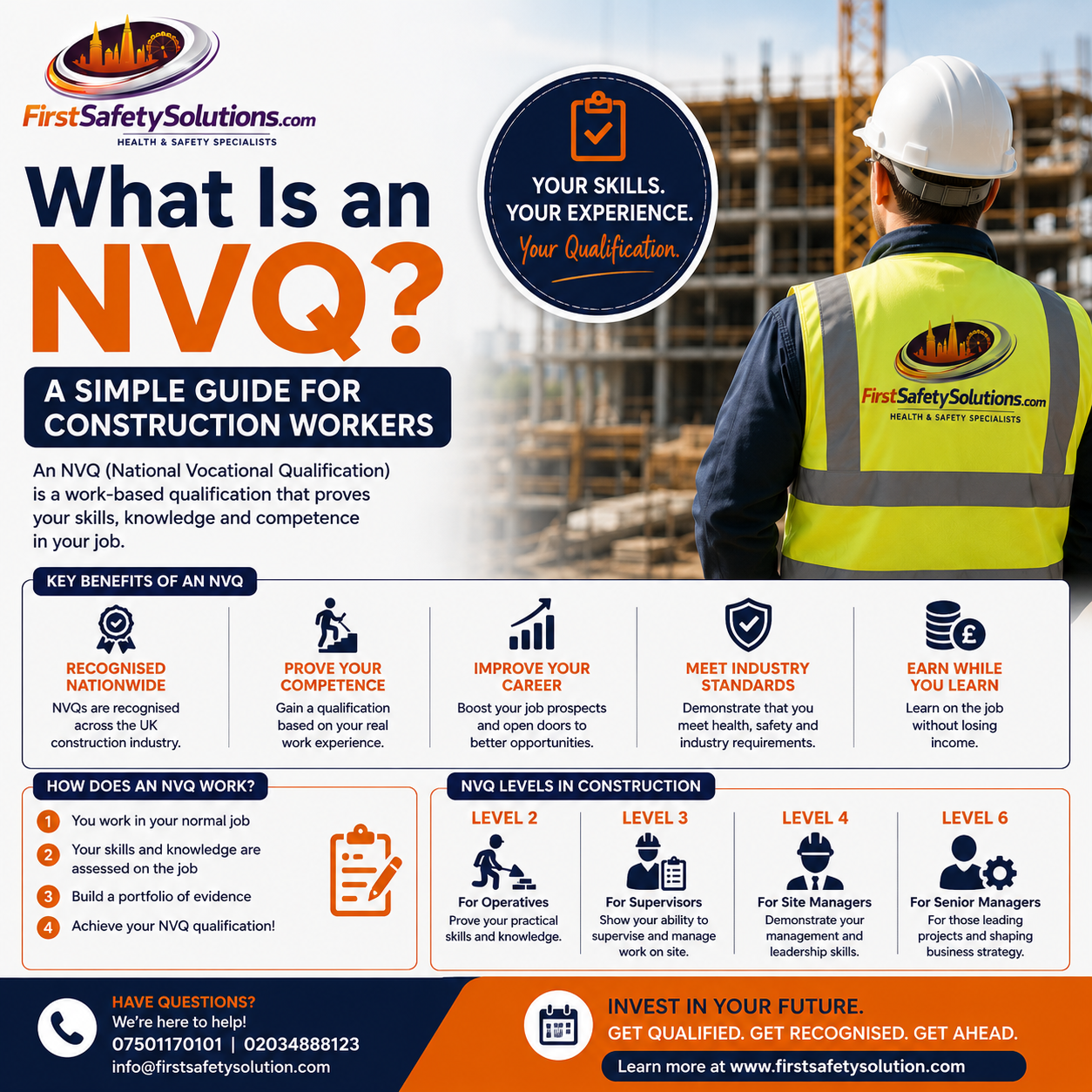
It is a work-based qualification that allows people to demonstrate their skills and competence in a particular occupation. Unlike a traditional classroom-based course, it focuses heavily on what you can do in a real working environment. For construction workers, this can make it a practical way to gain a recognized qualification while continuing to develop experience on site. it are available across many areas of construction, including site supervision, construction management, plant operations, occupational work supervision, and specialist trades.
Whether you are an experienced worker looking to formalize your skills or someone planning the next step in your construction career, understanding how it works can help you choose the right qualification. This guide explains what an it is, how NVQs work, the different levels available, who can take one, how assessment works, and how it can support your construction career.
What Is an NVQ?
NVQ stands for National Vocational Qualification.
It is a vocational qualification designed to assess whether someone can perform their job competently. Instead of relying mainly on written examinations, it normally involves demonstrating your skills and knowledge in a real or realistic working environment. This makes it particularly relevant to construction workers because much of construction is practical and experience-based.
For example, someone working as a site supervisor may already have years of practical experience. It can provide a structured way to demonstrate that competence against the requirements of a recognized qualification. It is therefore different from simply attending a short training course. A short course may teach you specific knowledge or skills, while an NVQ assesses whether you can consistently apply the required skills and knowledge in your occupation.
How Does an NVQ Work?
The process is based around assessment. When you enroll in an NVQ, you are normally assigned an assessor who helps you understand the qualification requirements and what evidence you need to provide. You then work through the relevant units or areas of competence. Your assessor reviews evidence showing that you can perform the required tasks to the expected standard.
Depending on the qualification, evidence may include the following:
- Workplace observations
- Photographs
- Work records
- Documents
- Witness testimonies
- Questions and professional discussions
- Existing qualifications
- Evidence from your normal work activities
The exact assessment method depends on the qualification and awarding organization. The important point is that your existing work can often provide much of the evidence needed for assessment.
Why Is It Popular in Construction?
Construction is a practical industry. Workers develop many skills through real projects, site experience, and working alongside experienced professionals. However, practical experience alone does not always provide formal evidence of competence. It can help bridge that gap.
For example, an experienced construction worker may know how to perform their role correctly but may not have a formal qualification demonstrating that competence. It provides a structured assessment route. This can be particularly useful when employers, contractors, or clients require workers to demonstrate recognized competence.
What Are the Different NVQ Levels?
They are available at different levels, with each level generally reflecting increasing complexity, responsibility, and knowledge. The appropriate level depends on your job role and experience.
NVQ Level 1
Level 1 qualifications are generally introductory and focus on basic knowledge and skills. They may be suitable for people starting out in an occupation. However, many experienced construction professionals will be working towards higher levels that better reflect their responsibilities.
NVQ Level 2
Level 2 qualifications are commonly associated with skilled or semi-skilled occupational roles. In construction, Level 2 NVQs can be relevant to workers who carry out practical activities within a particular trade or plant operation.
Examples can include qualifications relating to:
- Plant operations
- Groundworks
- Construction operations
- Specialist construction activities
The exact qualifications available depend on the occupation and training provider.
NVQ Level 3
Level 3 generally involves more advanced occupational competence. In construction, this can include supervisory and specialist responsibilities. A Level 3 qualification may be suitable for someone who has developed experience and is taking on additional responsibilities. For example, an occupational work supervisor may consider a relevant Level 3 NVQ as part of their professional development.
NVQ Level 4 and Above
Higher-level vocational qualifications can involve more complex responsibilities, management, planning, and decision-making. These can be relevant to experienced construction professionals moving into management.
NVQ Level 6
Level 6 qualifications are particularly relevant to senior construction management roles. For example, a construction professional working towards a career as a construction manager may consider a Level 6 NVQ in construction management.
The qualification can assess higher-level competencies involving areas such as:
- Managing construction projects
- Planning
- Leadership
- Health and safety
- Resource management
- Commercial considerations
- Quality management
The exact content depends on the qualification pathway.
Who Can Take an NVQ?
It is designed for people who want to demonstrate competence in a particular occupation.
You may be suitable for an NVQ if you are:
- Already working in construction
- An experienced tradesperson
- A site supervisor
- A construction manager
- A plant operator
- Working towards a promotion
- Looking to formalise existing skills
- Building evidence for career progression
One of the main advantages is that you do not necessarily have to start your career from the beginning to gain an NVQ. If you already have relevant workplace experience, that experience can potentially contribute towards your assessment.
Do You Need Construction Experience?
This depends on the specific qualification. Because NVQs assess occupational competence, many construction NVQs are most suitable for people who are already working in the relevant role or have access to an appropriate workplace environment. For example, it assessing site supervision will require you to demonstrate supervisory competence.
Someone with no supervisory responsibilities may therefore need to gain suitable experience before they can complete that qualification. Before enrolling, check the requirements of the specific NVQ you are considering.
What Evidence Is Needed for an NVQ?
Evidence is a major part of the NVQ assessment process. Your assessor needs to see evidence that you can perform the tasks required by the qualification.
Workplace Observation
Your assessor may observe you carrying out relevant activities. For construction workers, this can be particularly useful because it allows competence to be assessed in a real working environment.
Photographic Evidence
Photographs may sometimes be used to support your portfolio. For example, photographs could show completed work, equipment, or processes relevant to the qualification. Photographs normally need to be supported by appropriate evidence and must meet the qualification’s assessment requirements.
Workplace Documents
Documents produced as part of your normal work may provide useful evidence.
Depending on your role, this could include the following:
- Risk assessments
- Method statements
- Site records
- Inspection records
- Work schedules
- Quality records
- Project documentation
You should always follow your assessor’s guidance about what evidence is acceptable.
Witness Testimony
Someone who has observed your work may sometimes provide a witness testimony. This could potentially come from an appropriate supervisor, manager, or other competent person. The assessor will determine whether the testimony is suitable for the qualification.
Professional Discussion
An assessor may ask questions about your work. This gives you an opportunity to explain why you made certain decisions and demonstrate your understanding. For example, a construction supervisor might be asked how they manage risks, communicate with workers, or respond to changing site conditions.
How Long Does an NVQ Take?
There is no single timeframe that applies to every NVQ.
The length depends on several factors, including:
- The qualification level
- The occupational area
- Your existing experience
- How quickly you provide evidence
- Your access to suitable work activities
- The assessor’s schedule
- The amount of evidence required
An experienced worker who can regularly demonstrate the required competencies may progress more quickly than someone who needs to develop additional skills or gather more evidence. This is one reason why NVQs are flexible compared with some traditional classroom-based qualifications.
Can You Complete an NVQ While Working?
Yes. This is one of the main reasons it are attractive to construction professionals. The assessment is connected to your work, allowing you to gather evidence while carrying out your normal responsibilities. Instead of taking several weeks away from construction work for full-time classroom study, you can often work towards the qualification alongside your job. The exact arrangement depends on the qualification and provider.
Is an NVQ the Same as a Training Course?
No.
An NVQ and a short training course serve different purposes. A training course generally focuses on teaching specific knowledge or skills. It focuses on assessing competence against a defined occupational standard. For example, a construction worker might complete a short health and safety course to learn about particular safety responsibilities. An NVQ, on the other hand, could assess whether the worker can demonstrate the required competence in their occupational role. In some career pathways, both types of training can be valuable.
NVQ vs Apprenticeship
NVQs and apprenticeships are also different. An apprenticeship combines employment with structured training and an apprenticeship standard. An NVQ is a vocational qualification based around demonstrating occupational competence. An apprentice may complete a qualification or other recognized components as part of their apprenticeship, depending on the program. The right route depends on your career stage, employment situation, and goals.
Can an NVQ Help With a CSCS Card?
Some construction NVQs can be relevant to the qualification requirements associated with particular CSCS cards. However, having it does not automatically mean that you qualify for every CSCS card. The requirements depend on the specific occupation, card type, and current CSCS rules. If you are considering an NVQ because you need a particular CSCS card, check the current requirements before enrolling. Do not choose it solely because you assume it will automatically provide a particular card.
How Can an NVQ Help Your Construction Career?
An NVQ can provide several potential benefits for construction professionals.
Formal Recognition of Your Skills
You may have years of practical experience but no formal qualification that reflects your ability. It gives you a structured way to demonstrate competence.
Career Progression
A recognized qualification can support progression into roles with greater responsibility.
For example:
Construction Worker → Skilled Worker → Supervisor → Manager
The exact career path depends on your trade, experience, and employer.
Demonstrating Competence
Construction companies often need competent workers and supervisors. It can provide formal evidence of occupational competence.
Supporting Professional Development
Continuing professional development is important in a changing construction industry. It can form part of a broader professional development plan alongside other courses, qualifications, and workplace experience.
Learning Through Your Job
Because it are work-based, you can develop your qualifications while continuing to gain practical experience. This makes the route particularly suitable for working construction professionals.
Which NVQ Is Right for You?
Choosing the correct qualification is important. Do not simply choose the highest level available. The qualification should match your actual job role and responsibilities.
Ask yourself:
- What is my current job?
- What activities do I carry out?
- What responsibilities do I have?
- What qualification does my employer require?
- Am I planning a promotion?
- Do I need a qualification for a specific career pathway?
- Do I need a particular qualification for a CSCS card?
For example, a person working as a skilled plant operator may need a very different NVQ from a construction manager.
Examples of NVQs for Construction Workers
There are many construction-related pathways.
Depending on your role and experience, you may find qualifications relating to:
- Construction operations
- Plant operations
- Occupational work supervision
- Construction site supervision
- Construction management
- Building maintenance
- Specialist trades
- Civil engineering
The availability of specific qualifications can change, so always check the current qualification information before making a decision.
NVQ Level 2 for Construction Workers
Level 2 can be particularly relevant to workers who perform practical occupational duties. For example, an experienced plant operator may be able to work towards a relevant Level 2 qualification while continuing their normal job. The assessment focuses on whether the worker can demonstrate the required skills and knowledge. This can provide a formal qualification that reflects practical ability.
NVQ Level 3 for Supervisors
A worker who has progressed into supervision may need a qualification that reflects their increased responsibilities. A relevant Level 3 NVQ can provide a pathway for demonstrating supervisory competence.
The evidence may involve areas such as:
- Planning work
- Supervising workers
- Monitoring performance
- Managing resources
- Communicating information
- Supporting health and safety
- Maintaining quality
Again, the exact requirements depend on the qualification.
NVQ Level 6 for Construction Management
Experienced construction professionals considering senior management roles may look at Level 6 qualifications. A Level 6 construction management it can assess higher-level responsibilities and management competence.
This can be relevant to people working towards roles such as:
- Construction manager
- Senior site manager
- Project manager
- Contracts manager
The qualification should be selected according to the person’s actual responsibilities and career objectives.
What Is the Difference Between NVQ and CITB Training?
CITB provides and supports various construction training schemes, but it is a different type of qualification. For example, courses such as SMSTS and SSSTS focus on specific construction health and safety responsibilities. It focuses on demonstrating occupational competence. This means they can complement each other.
A construction manager could potentially have the following:
- Practical construction experience
- An qualification
- SMSTS training
- Additional health and safety training
- Other professional qualifications
Each can serve a different purpose.
Can You Have an NVQ and SMSTS?
Yes.
There is no general rule saying you must choose between an NVQ and SMSTS. They address different areas of professional development. It can demonstrate occupational competence, while SMSTS provides management-focused health and safety training. For a construction manager, having both may support a broader professional development profile, depending on the requirements of the employer and role.
How to Choose an NVQ Provider
Before choosing a provider, take time to check what is included.
Consider:
- Qualification title
- Qualification level
- Awarding organisation
- Assessment method
- Evidence requirements
- Assessor support
- Expected completion process
- Total cost
- Payment arrangements
- Entry or workplace requirements
Do not choose solely on price. A clear assessment process and appropriate support can make a significant difference to your experience.
What Should You Ask Before Enrolling?
Before paying for it, ask the provider:
Is the Qualification Right for My Job?
The qualification should match your actual occupational responsibilities.
What Evidence Will I Need?
Ask what evidence is normally required and whether your current work can provide it.
How Will I Be Assessed?
Find out whether assessment involves workplace observation, professional discussion, portfolio evidence, or other methods.
How Long Could It Take?
Ask for an estimated timeframe based on your experience and working situation.
Who Will Assess Me?
Understanding how assessor support works can help you know what to expect.
Common Mistakes When Choosing an NVQ
There are several mistakes construction workers can avoid.
Choosing the Wrong Level
Higher is not always better. The qualification needs to match your job role.
Choosing a Qualification Without Checking the Requirements
Make sure you can access the workplace activities and evidence required.
Focusing Only on Price
A cheap qualification may not provide the level of support you need.
Assuming Every NVQ Gives the Same Career Benefits
Different NVQs relate to different occupations. Choose one that supports your actual career direction.
Leaving Evidence Until the End
Keeping evidence organized throughout the process can make assessment easier.
How to Prepare for an NVQ
Good preparation can make the qualification process smoother. Start by understanding the qualification requirements. Then speak with your assessor about the evidence you can provide. Keep relevant documents organized. If photographs are required, make sure they are clear and appropriate. Keep records of your work activities where relevant. Most importantly, communicate with your assessor if you are unsure about anything.
Is an NVQ Worth It for Construction Workers?
For many experienced construction professionals, it can be a valuable qualification because it recognizes competence gained through practical work.
It can be particularly useful for people who:
- Have substantial site experience
- Want formal recognition of their skills
- Are seeking career progression
- Are moving into supervision
- Are preparing for management
- Need a relevant qualification for their professional pathway
However, the value depends on choosing the right qualification for your role. It should be part of a wider career plan rather than simply something to collect.
Frequently Asked Questions
What is an NVQ?
It is National Vocational Qualification, is a work-based qualification that assesses whether a person can demonstrate competence in a particular occupation.
Is an NVQ a real qualification?
Yes. it is recognized vocational qualifications designed around occupational competence. The exact recognition and use depend on the qualification and awarding organization.
Are NVQs only for construction workers?
No. NVQs and other vocational qualifications exist across many industries. Construction is one of the sectors where work-based qualifications are particularly common.
Can I complete an NVQ while working?
Yes. Many NVQs are designed to be completed while you are working because assessment is based on demonstrating competence in a workplace environment.
Do I need experience to complete an NVQ?
Requirements vary. Because it assess practical competence, many construction NVQs are most suitable for people already working in the relevant occupation.
How long does an NVQ take?
There is no universal timeframe. It depends on the qualification, your experience, access to suitable work activities, and how quickly you can provide the required evidence.
Is an NVQ better than a college course?
Neither is automatically better. They have different purposes. It focuses on occupational competence, while a college course may provide broader theoretical or classroom-based learning.
Can an NVQ help with career progression?
Yes. A relevant NVQ can provide formal recognition of your competence and may support progression into more skilled, supervisory, or management roles.
What is an NVQ Level 2?
An NVQ Level 2 generally focuses on occupational skills and competence at a practical level. In construction, various Level 2 qualifications are available for skilled and specialist roles.
What is an NVQ Level 3?
Level 3 qualifications generally involve more advanced occupational competence and can be relevant to skilled, supervisory, or specialist roles.
What is an NVQ Level 6?
Level 6 qualifications are higher-level vocational qualifications and can be relevant to experienced professionals with management-level responsibilities.
Is an NVQ the same as SMSTS?
No. It assesses occupational competence, while SMSTS is a CITB Site Safety Plus course focused on health and safety management responsibilities.
Can I have an NVQ and SMSTS?
Yes. They serve different purposes and can complement each other depending on your construction role and career objectives.
Final Thoughts
So, what is an NVQ?
It is a work-based qualification designed to assess whether you can demonstrate the skills, knowledge, and competence required for a particular occupation. For construction workers, this approach can be especially useful because practical experience is an important part of working in the industry. Whether you are a skilled worker, plant operator, supervisor, or construction manager, there may be it pathway that matches your role and career goals.
The most important step is choosing the right qualification. Think about your current responsibilities, your experience, and where you want your career to go next. Then select an NVQ that genuinely reflects your work. If you are looking for construction-related qualifications, you can explore the NVQ courses available from First Safety Solution.
For construction professionals who are also looking for health and safety training, First Safety Solution provides CITB courses covering areas such as site supervision and site management. It is not simply a certificate. Done correctly, it can provide formal recognition of skills you have developed through real construction work and help you take the next step in your career.