Introduction to the Benefits of CHAS Accreditation
Health and safety are at the heart of every successful construction business. In today’s competitive UK construction industry, clients expect contractors to demonstrate not only technical expertise but also a strong commitment to workplace safety and legal compliance. One of the most recognized ways to achieve this is by obtaining CHAS (Contractors Health and Safety Assessment Scheme) accreditation. The Benefits of CHAS Accreditation extend far beyond meeting basic health and safety requirements. Accreditation helps construction companies improve their reputation, win more contracts, strengthen compliance, and build long-term trust with clients. Whether you are a sole trader, a small contractor, or a large construction company, becoming CHAS accredited can give your business a significant competitive advantage.
Many public sector organizations, local authorities, housing associations, and private developers now require contractors to hold recognized health and safety accreditation before they can tender for projects. This means CHAS accreditation is no longer simply a badge of quality—it has become an essential business asset for companies looking to grow. In this guide, we’ll explore the Benefits of CHAS Accreditation, explain why it matters in 2026, and show how construction companies can use accreditation to improve compliance, increase tender opportunities, and support sustainable business growth.
What Is CHAS Accreditation?
CHAS (Contractors Health and Safety Assessment Scheme) is one of the UK’s leading providers of health and safety accreditation. Established in 1997, CHAS helps organizations assess the competence of contractors by evaluating their health and safety management systems against recognized industry standards.
Official CHAS website: https://www.chas.co.uk/
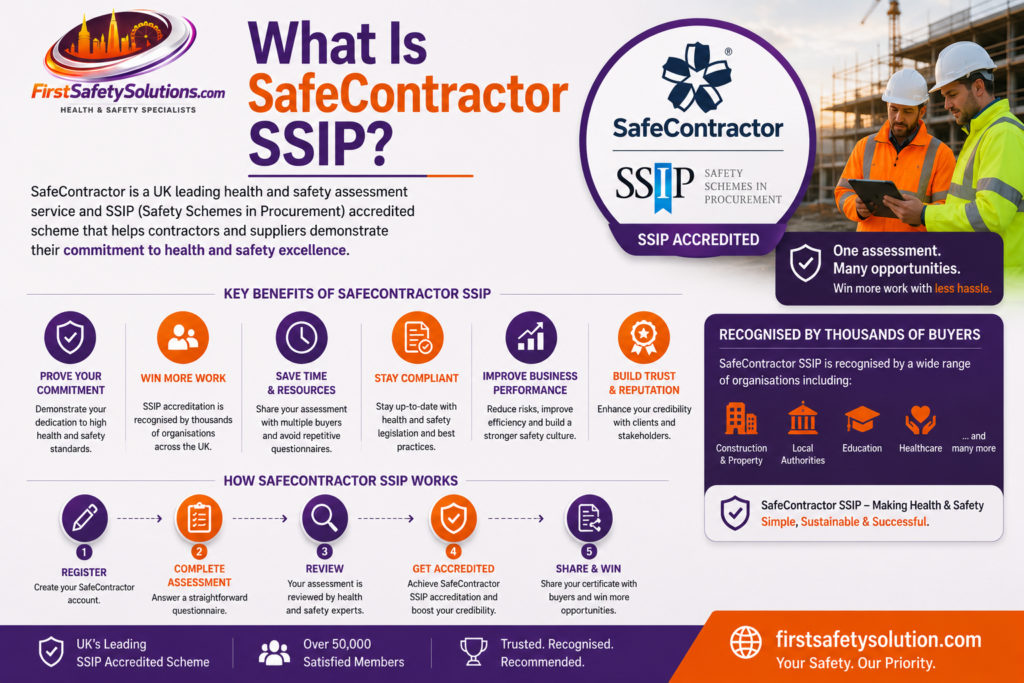
The scheme is widely recognized across the UK construction sector and forms part of the Safety Schemes in Procurement (SSIP) framework.
Official SSIP website: https://www.ssip.org.uk/
Successfully achieving CHAS accreditation demonstrates that a contractor has effective systems in place to manage workplace risks, comply with health and safety legislation, and protect employees, subcontractors, clients, and members of the public.
The assessment typically reviews:
-
Health and safety policy
-
Risk assessments
-
Method statements
-
Training records
-
Competency evidence
-
Insurance documentation
-
Accident reporting procedures
-
Equipment inspection records
-
Management systems
Completing the accreditation process provides independent verification that your business meets recognised health and safety standards.
For expert support with your application, visit: https://firstsafetysolution.com/accreditation/chas-accreditation-uk/
Why CHAS Accreditation Matters in 2026
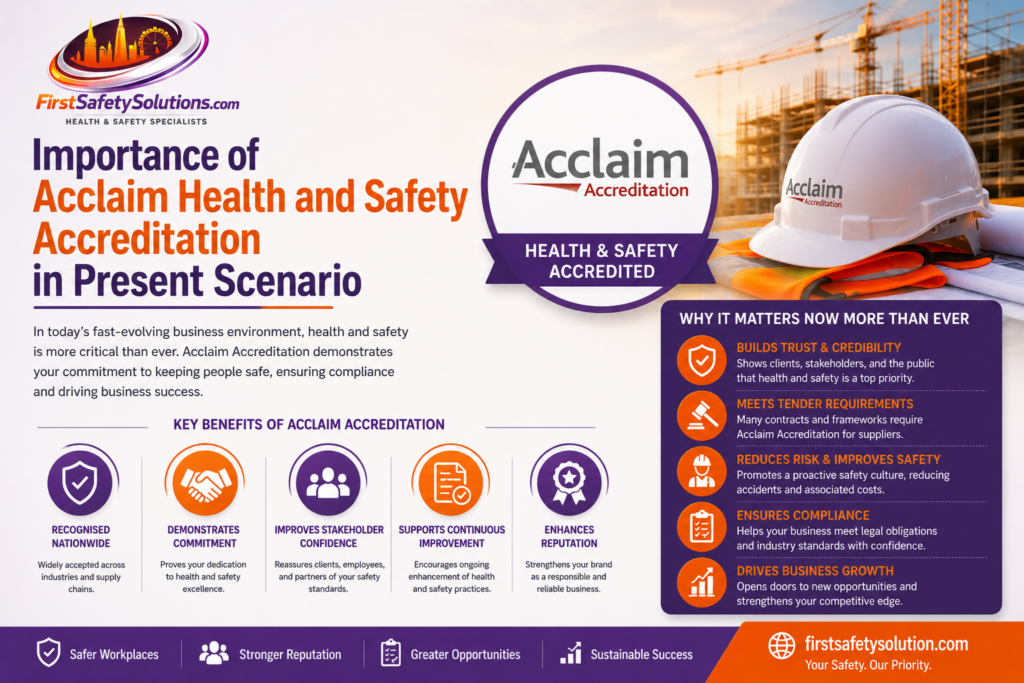
Construction remains one of the UK’s highest-risk industries. Every construction project involves potential hazards, including working at height, heavy machinery, electrical systems, excavations, manual handling, and vehicle movements. As health and safety expectations continue to increase, clients are becoming more selective when choosing contractors. Many organizations now require recognised Health and Safety Accreditation before awarding contracts. This growing emphasis on compliance is one of the main reasons the Benefits of CHAS Accreditation have become increasingly valuable.
In 2026, accreditation supports businesses by helping them:
-
Demonstrate legal compliance
-
Improve tender success
-
Reduce procurement barriers
-
Build client confidence
-
Strengthen workplace safety
-
Improve operational efficiency
Contractors without recognized accreditation may find themselves excluded from valuable opportunities, particularly within public sector procurement and major commercial projects. As supply chains become more compliance-focused, businesses that invest in recognized accreditation are better positioned for long-term success.
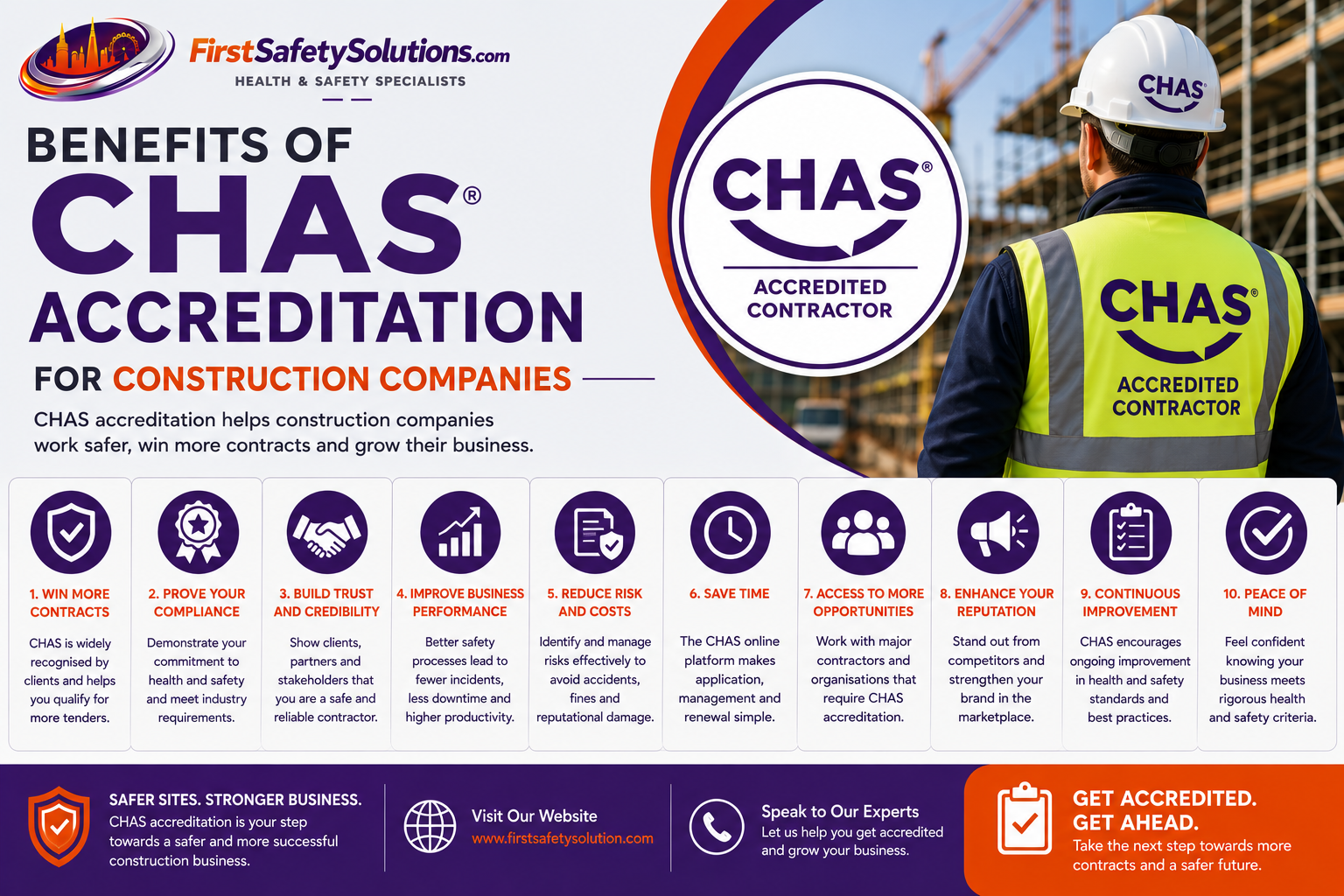
10 Proven Benefits of CHAS Accreditation for Construction Companies
The Benefits of CHAS Accreditation affect almost every aspect of a construction business. From improving safety management to strengthening commercial opportunities, accreditation provides measurable value that extends well beyond compliance. Below are the first five key benefits that construction companies can expect after becoming CHAS accredited.
Helps Win More Construction Contracts
Perhaps the biggest of all the Benefits of CHAS Accreditation is the opportunity to compete for more work. Many clients now require contractors to demonstrate recognised health and safety competence before inviting them to tender.
These clients include:
-
Local authorities
-
Government departments
-
Housing associations
-
Property developers
-
Principal contractors
-
Facilities management companies
-
Infrastructure organisations
Without recognised accreditation, some contractors may be unable to participate in procurement processes at all. CHAS accreditation helps businesses satisfy pre-qualification requirements and provides assurance that appropriate safety management systems are already in place. This allows procurement teams to assess contractors more efficiently while reducing perceived project risks. For growing businesses, accreditation can therefore open doors to projects that may previously have been inaccessible.
Demonstrates Health and Safety Compliance
Another significant advantage among the Benefits of CHAS Accreditation is demonstrating compliance with UK health and safety legislation.
Construction companies have legal responsibilities to:
-
Protect employees
-
Manage workplace hazards
-
Provide suitable training
-
Maintain safe systems of work
-
Assess workplace risks
CHAS accreditation helps demonstrate that these responsibilities are being managed effectively. During assessment, contractors must provide evidence covering multiple compliance areas.
Examples include:
| Compliance Area | Evidence Required |
|---|---|
| Health and Safety Policy | Written company policy |
| Risk Assessments | Hazard identification and controls |
| Method Statements | Safe working procedures |
| Insurance | Valid liability insurance |
| Employee Training | Competency records |
| Accident Reporting | Incident management procedures |
Meeting these standards reassures clients that health and safety is taken seriously throughout the organisation. Rather than relying solely on self-declaration, accreditation provides independent confirmation of compliance.
Improves Client Trust and Business Reputation
Trust plays a major role when clients select contractors. One of the most valuable Benefits of CHAS Accreditation is the confidence it creates among clients, suppliers, and business partners. Construction projects involve significant financial investment and operational risk.
Clients, therefore, prefer working with contractors who can demonstrate the following:
-
Professionalism
-
Competence
-
Reliability
-
Compliance
-
Strong safety management
CHAS accreditation provides visible evidence that your company has successfully completed an independent assessment.
This often improves confidence during:
-
Tender evaluations
-
Supplier selection
-
Contract negotiations
-
Long-term partnerships
A stronger reputation can also generate referrals and repeat business. Companies known for maintaining high health and safety standards are often viewed as lower-risk partners, making them more attractive within competitive procurement processes.
Reduces Procurement Delays
Procurement can become time-consuming when clients need to verify a contractor’s health and safety arrangements manually. One of the practical Benefits of CHAS Accreditation is reducing this administrative burden. Instead of reviewing every policy and procedure individually, clients can rely on recognised accreditation as evidence that key compliance standards have already been assessed. This can streamline procurement by reducing repeated requests for documentation.
Benefits include:
-
Faster supplier approval
-
Reduced paperwork
-
Simpler pre-qualification
-
Improved procurement efficiency
-
Reduced duplication of assessments
For contractors, this means less time responding to compliance requests and more time focusing on project delivery. Businesses that regularly tender for work often find that accreditation simplifies multiple procurement processes throughout the year.
Supports SSIP Recognition
Another important reason many businesses seek CHAS accreditation is its recognition under the Safety Schemes in Procurement (SSIP) framework. This is one of the most commercially valuable Benefits of CHAS Accreditation because SSIP helps reduce duplication across contractor assessments. Rather than completing multiple health and safety assessments for different clients, accredited contractors may be able to demonstrate compliance through their SSIP-recognized accreditation.
Advantages include:
-
Reduced administrative work
-
Greater industry recognition
-
Improved supply chain acceptance
-
More efficient contractor assessment
-
Increased procurement consistency
This makes CHAS particularly valuable for contractors working with multiple clients across different sectors. As procurement standards continue to evolve, SSIP recognition remains an important factor influencing contractor selection throughout the UK.
Summary of the First Five Benefits
The first five Benefits of CHAS Accreditation demonstrate why accreditation has become such an important investment for UK construction companies.
| Benefit | Business Impact |
|---|---|
| Win More Contracts | Access to additional tender opportunities |
| Demonstrate Compliance | Shows commitment to health and safety legislation |
| Improve Client Trust | Builds confidence and strengthens reputation |
| Reduce Procurement Delays | Speeds up supplier approval processes |
| Support SSIP Recognition | Reduces duplicate health and safety assessments |
These benefits not only improve compliance but also contribute to stronger commercial performance, helping construction businesses compete more effectively in an increasingly regulated marketplace.
Strengthens Risk Management
Effective risk management is essential for every construction company, regardless of its size or speciality. One of the most practical Benefits of CHAS Accreditation is that it encourages businesses to develop, implement, and maintain robust health and safety management systems.
Construction sites present a wide range of hazards, including:
-
Working at height
-
Manual handling
-
Excavations
-
Electrical installations
-
Moving vehicles
-
Heavy machinery
-
Hazardous substances
CHAS accreditation requires contractors to identify these risks, assess their impact, and implement suitable control measures. By following a structured approach to risk management, businesses can:
-
Reduce workplace accidents
-
Minimise project delays
-
Improve employee confidence
-
Lower the likelihood of enforcement action
-
Protect their reputation
Strong risk management not only benefits employees but also reassures clients that projects will be delivered safely and professionally.
Enhances Employee Safety Culture
Health and safety is more than a collection of policies—it is a culture that should be embedded throughout an organisation. Among the long-term Benefits of CHAS Accreditation is the development of a stronger safety culture.
Accreditation encourages businesses to:
-
Deliver regular training
-
Conduct toolbox talks
-
Review safe working procedures
-
Encourage hazard reporting
-
Promote employee engagement
When employees understand their responsibilities and actively participate in safety initiatives, workplaces become safer and more productive.
A positive safety culture can also lead to:
-
Improved staff morale
-
Higher productivity
-
Reduced absenteeism
-
Better teamwork
-
Increased workforce confidence
Construction companies that invest in safety often experience fewer disruptions and stronger operational performance.
Gives a Competitive Advantage
The UK construction industry is highly competitive, with contractors often competing for the same tenders. One of the strongest Benefits of CHAS Accreditation is the competitive advantage it provides during procurement. Many clients use health and safety accreditation as part of their contractor selection criteria. Being CHAS accredited demonstrates that your business has already been independently assessed against recognized standards.
This can help your business:
-
Stand out from competitors
-
Meet pre-qualification requirements
-
Improve tender scores
-
Build procurement confidence
-
Access larger projects
While accreditation alone does not guarantee success, it significantly strengthens your position when competing for contracts.
Supports Business Growth
Many businesses initially pursue accreditation to satisfy client requirements. However, they soon discover that one of the greatest Benefits of CHAS Accreditation is its ability to support long-term growth.
As businesses expand, they often seek opportunities within:
-
Public sector procurement
-
Infrastructure projects
-
Commercial developments
-
Housing associations
-
Facilities management contracts
Many of these opportunities require recognized health and safety accreditation before contractors can even submit a tender. By achieving CHAS accreditation, construction companies position themselves for sustainable growth and increased revenue opportunities.
Growth benefits include the following:
-
Access to larger contracts
-
Increased client confidence
-
Improved business credibility
-
Greater market visibility
-
Enhanced professional reputation
For many contractors, accreditation becomes an investment rather than an expense.
Simplifies Supply Chain Compliance
Modern construction projects involve multiple contractors, subcontractors, suppliers, and consultants. Managing compliance across complex supply chains can be challenging. Another important Benefits of CHAS Accreditation is simplifying supply chain management. Many principal contractors prefer working with accredited suppliers because accreditation provides independent evidence of health and safety competence.
This can reduce:
-
Duplicate assessments
-
Administrative workload
-
Procurement delays
-
Compliance uncertainty
For contractors working across multiple projects, recognized accreditation can significantly improve efficiency when joining new supply chains.
CHAS Accredited vs Non-Accredited Construction Companies
The following comparison highlights the practical differences between accredited and non-accredited businesses.
| Feature | CHAS Accredited Company | Non-Accredited Company |
|---|---|---|
| Independent Health and Safety Assessment | ✔ | ✘ |
| SSIP Recognition | ✔ | ✘ |
| Improved Tender Eligibility | ✔ | Limited |
| Increased Client Confidence | ✔ | Varies |
| Structured Compliance Systems | ✔ | May vary |
| Enhanced Business Reputation | ✔ | Limited evidence |
| Easier Procurement Process | ✔ | Often requires additional checks |
| Competitive Advantage | ✔ | Lower |
Although some clients may not require accreditation, many increasingly view recognised certification as evidence of professionalism and reliability.
Industries That Benefit from CHAS Accreditation
Although CHAS is closely associated with construction, its benefits extend across many industries.
Examples include:
| Industry | Typical Benefits |
|---|---|
| Construction | Tender eligibility and compliance |
| Civil Engineering | Client confidence and risk management |
| Electrical Contractors | Improved procurement opportunities |
| Plumbing and Heating | Demonstrated competency |
| Roofing | Health and safety compliance |
| Facilities Management | Supply chain approval |
| Landscaping | Enhanced reputation |
| Mechanical Engineering | Independent safety assessment |
This wide recognition makes accreditation valuable across numerous sectors.
Common Misconceptions About CHAS Accreditation
Despite its popularity, several misconceptions still exist regarding CHAS accreditation.
“Only Large Companies Need CHAS”
This is incorrect.
Sole traders, SMEs, and growing contractors can all benefit from accreditation.
“CHAS Guarantees Contracts”
Accreditation does not guarantee work.
Instead, it improves eligibility, demonstrates competence, and strengthens tender submissions.
“The Process Is Too Complicated”
With organised documentation and professional support where needed, many businesses complete the process successfully without unnecessary difficulty.
“Health and Safety Is Only Paperwork”
One of the most important Benefits of CHAS Accreditation is encouraging businesses to develop practical safety systems rather than simply producing documentation.
Good health and safety management protects people, reduces risks, and supports successful project delivery.
How First Safety Solution Can Help
Preparing for CHAS accreditation can be challenging, particularly for businesses applying for the first time. First Safety Solution provides expert support throughout the accreditation journey.
Services include:
-
CHAS application assistance
-
Health and safety policy preparation
-
Risk assessment reviews
-
Method statement development
-
Compliance gap analysis
-
Documentation support
-
Ongoing health and safety advice
Useful resources:
CHAS Accreditation: https://firstsafetysolution.com/accreditation/chas-accreditation-uk/
CHAS Assist UK: https://firstsafetysolution.com/shop/chas-assist-uk/
Accreditation Hub: https://firstsafetysolution.com/accreditation/
Working with experienced consultants helps reduce delays, improve documentation quality, and increase the likelihood of successful accreditation.
Frequently Asked Questions
1. What are the main Benefits of CHAS Accreditation?
The main Benefits of CHAS Accreditation include improved health and safety compliance, increased tender opportunities, enhanced client confidence, SSIP recognition, stronger risk management, and better business reputation.
2. Is CHAS accreditation recognised across the UK?
Yes. CHAS is one of the UK’s most recognized health and safety accreditation schemes and is widely accepted by public and private sector organisations.
3. Is CHAS part of the SSIP Scheme?
Yes. CHAS is recognized under the Safety Schemes in Procurement (SSIP) framework.
4. Can sole traders apply for CHAS accreditation?
Yes. Sole traders can apply provided they meet the relevant assessment requirements and maintain appropriate health and safety arrangements.
5. Does CHAS accreditation guarantee winning contracts?
No. Accreditation does not guarantee contract awards, but it improves eligibility, demonstrates compliance, and strengthens tender submissions.
6. How often does CHAS accreditation need renewing?
CHAS accreditation normally requires annual renewal to ensure contractors continue meeting recognized health and safety standards.
7. Can CHAS accreditation improve business reputation?
Yes. Independent accreditation demonstrates professionalism, competence, and commitment to maintaining high health and safety standards.
8. Do I need professional support to apply?
Professional support is not mandatory, but many contractors choose expert guidance to improve documentation quality and reduce application delays.
Conclusion
The Benefits of CHAS Accreditation extend far beyond achieving compliance with health and safety regulations. Accreditation demonstrates professionalism, strengthens risk management, enhances employee safety, improves client confidence, and creates valuable opportunities for business growth. For construction companies operating in an increasingly competitive market, CHAS accreditation can provide a significant advantage during procurement while supporting stronger health and safety management across every project. Whether you are a sole trader, a growing SME, or an established contractor, investing in accreditation demonstrates your commitment to high standards and continuous improvement.
By understanding and taking advantage of the Benefits of CHAS Accreditation, businesses can strengthen their reputation, improve compliance, simplify procurement, and position themselves for long-term success. If you need assistance preparing your application or maintaining compliance, First Safety Solution can provide expert guidance every step of the way.