CHAS Accreditation Requirements Checklist for UK Contractors
What Are CHAS Accreditation Requirements?
CHAS Accreditation Requirements are the health and safety standards, policies, procedures, and supporting evidence that contractors must demonstrate to achieve CHAS accreditation. As a founding member of the SSIP framework, CHAS assesses businesses against recognized health and safety criteria designed to demonstrate competence, compliance, and effective risk management.
For many UK contractors, meeting CHAS Accreditation Requirements is essential for winning contracts, passing pre-qualification checks, and demonstrating compliance with UK health and safety legislation. Businesses that achieve CHAS accreditation can strengthen their reputation, improve tender opportunities, and show clients they operate safe and compliant systems.
If you are looking for professional support, visit the following:
- https://firstsafetysolution.com/accreditation/chas-accreditation-uk/
- https://firstsafetysolution.com/shop/chas-assist-uk/
Why CHAS Accreditation Is Important
Many contractors are asked to provide evidence of health and safety competence before being awarded work.
CHAS accreditation helps businesses:
- Demonstrate health and safety compliance
- Meet SSIP requirements
- Reduce duplication of assessments
- Improve credibility
- Access more tender opportunities
- Meet client pre-qualification requirements
CHAS is recognized across the UK construction and contractor sectors and is one of the most widely accepted health and safety accreditation schemes.
Complete CHAS Accreditation Requirements Checklist
Before applying, ensure your business has the following documentation and systems in place.
1. Health and Safety Policy
A current Health and Safety Policy is one of the most important CHAS Accreditation Requirements.
Your policy should include:
- Company details
- Health and safety objectives
- Management responsibilities
- Employee responsibilities
- Arrangements for managing risks
Businesses with five or more employees are generally expected to have a documented policy.
For assistance with documentation review, visit: https://firstsafetysolution.com/shop/health-and-safety-policy-review/
2. Competent Health and Safety Advice
Under the Management of Health and Safety at Work Regulations 1999, businesses must have access to competent health and safety advice.
This can be:
- An internal competent person
- An external health and safety consultant
- A retained health and safety adviser
Evidence may include:
- Qualifications
- Professional memberships
- Consultancy agreements
A competent adviser is a key requirement for successful accreditation.
3. Risk Assessments
Risk assessments demonstrate that hazards have been identified and controlled.
Common examples include:
- Construction activities
- Working at height
- Manual handling
- COSHH activities
- Equipment use
- Fire risks
Assessments should be current and relevant to the work undertaken.
4. Method Statements
Method statements explain how work will be completed safely.
These documents should include:
- Work activities
- Hazards
- Control measures
- Emergency arrangements
- Responsibilities
Well-written method statements improve application quality and reduce assessor queries.
5. Training Records
CHAS assessors often review evidence of workforce competence.
Examples include:
- SMSTS
- SSSTS
- First Aid Training
- Working at Height Training
- Manual Handling Training
- Fire Safety Training
- COSHH Awareness Training
Training records should be up to date and relevant to job roles.
6. Accident and Incident Procedures
Your business should have procedures for:
- Accident reporting
- Incident investigations
- Near miss reporting
- Corrective actions
You may also need:
- Accident records
- Investigation reports
- Improvement actions
These documents demonstrate active safety management.
7. Insurance Documentation
Insurance verification forms part of the assessment process. CHAS Standard includes an insurance module as part of demonstrating compliance.
Typical requirements include the following:
- Employers’ Liability Insurance
- Public Liability Insurance
- Professional Indemnity Insurance (where applicable)
Keep policies current and available for review.
8. COSHH Management
Businesses using hazardous substances should have:
- COSHH assessments
- Safety Data Sheets
- Storage procedures
- Employee training records
CHAS assessors may review how hazardous substances are managed.
9. Equipment Inspection Records
You may need evidence relating to:
- Ladders
- Power tools
- Lifting equipment
- Plant machinery
- PPE
Inspection and maintenance records help demonstrate ongoing compliance.
10. Employee Competence Records
CHAS Accreditation Requirements include demonstrating workforce competence.
Evidence may include:
- CSCS cards
- CPCS cards
- NPORS cards
- NVQ qualifications
- Trade qualifications
- Training certificates
Maintaining accurate records strengthens your application.
CHAS Accreditation Requirements Checklist Table
| Requirement | Required |
|---|---|
| Health & Safety Policy | Yes |
| Competent H&S Adviser | Yes |
| Risk Assessments | Yes |
| Method Statements | Yes |
| Insurance Evidence | Yes |
| Training Records | Yes |
| Accident Procedures | Yes |
| COSHH Assessments | Where Applicable |
| Equipment Inspections | Where Applicable |
| Competence Records | Yes |
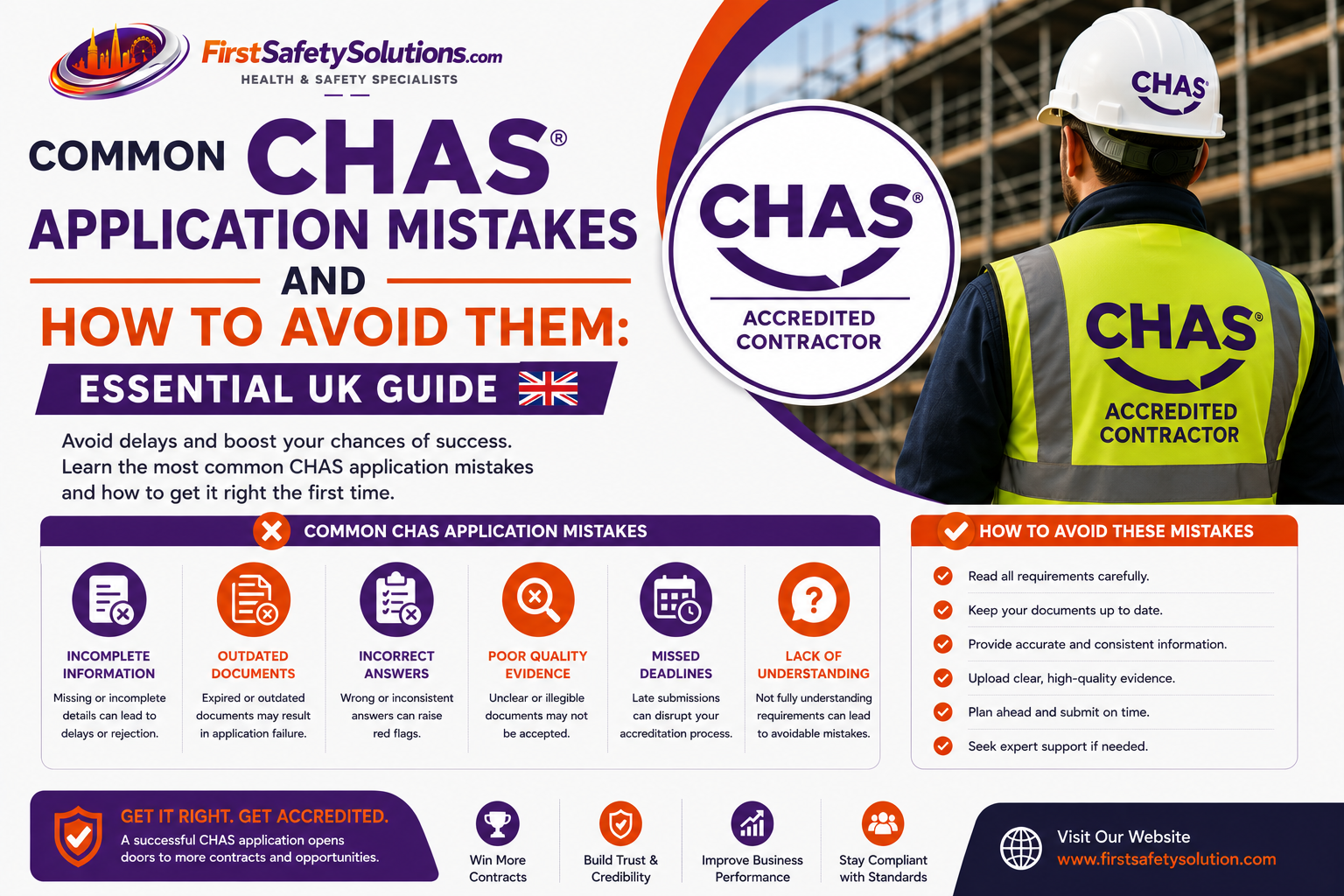
Common Reasons CHAS Applications Are Rejected
Many applications experience delays because of:
- Missing policies
- Outdated risk assessments
- Incomplete training records
- Missing insurance documents
- Lack of competent health and safety advice
- Poor document organisation
Preparing documentation properly before submission can significantly improve approval success.
How Long Does It Take to Meet CHAS Accreditation Requirements?
The timeframe depends on:
- Existing documentation
- Company size
- Complexity of operations
- Availability of evidence
Businesses with well-organized systems can often complete the process quickly, while those needing documentation updates may require additional preparation. CHAS states assessments are typically processed within around 10 days, with faster options available in some circumstances.
How First Safety Solution Can Help
First Safety Solution provides expert support for businesses seeking CHAS accreditation.
Our services include:
- Documentation review
- Health and safety policy support
- Risk assessment guidance
- Application preparation
- Submission assistance
- Compliance support
Useful links:
- https://firstsafetysolution.com/accreditation/chas-accreditation-uk/
- https://firstsafetysolution.com/shop/chas-assist-uk/
- https://firstsafetysolution.com/accreditation/
For official guidance, visit:
Why Clients Require CHAS Accreditation
Many public and private sector organisations prefer to work with contractors who can demonstrate strong health and safety standards. CHAS accreditation provides independent verification that a business has appropriate policies, procedures, and management systems in place.
Clients often use CHAS accreditation as part of their contractor selection process because it helps reduce risk and ensures suppliers meet recognised industry standards. For contractors, meeting CHAS Accreditation Requirements can improve credibility and increase opportunities to secure new contracts.
Benefits include:
- Increased client confidence
- Improved tender success rates
- Reduced pre-qualification paperwork
- Demonstration of legal compliance
- Enhanced business reputation
Businesses that invest time in meeting CHAS Accreditation Requirements often find that accreditation supports long-term growth and helps them compete for larger projects.
Documents Required for CHAS Accreditation
One of the most common questions contractors ask is what documentation is needed to satisfy CHAS Accreditation Requirements.
Typical documents include:
- Health and Safety Policy
- Risk Assessments
- Method Statements
- Training Records
- Insurance Certificates
- Accident Reporting Procedures
- Competent Health and Safety Adviser Details
- COSHH Assessments
- Equipment Inspection Records
- Emergency Procedures
Keeping documentation organised before applying can significantly improve the assessment process and reduce delays. Businesses should review all documents regularly to ensure they remain current and accurately reflect company operations.
CHAS Accreditation Requirements for Small Businesses
Small businesses often assume CHAS accreditation is only suitable for large contractors. However, CHAS Accreditation Requirements apply to businesses of all sizes, including sole traders and SMEs.
Small businesses can benefit from accreditation because it:
- Demonstrates professionalism
- Helps secure contracts
- Improves safety management
- Supports business growth
- Enhances client trust
Although documentation requirements may seem extensive, many small businesses already have systems in place and simply need assistance presenting evidence correctly.
CHAS Accreditation Requirements for Construction Contractors
Construction companies represent one of the largest groups applying for CHAS accreditation.
Construction-related CHAS Accreditation Requirements often focus on:
- Working at Height Procedures
- Site Safety Management
- Construction Risk Assessments
- Plant and Equipment Inspections
- Workforce Competence
- Contractor Management
- Accident Prevention
Construction businesses must demonstrate that health and safety risks are actively managed and that employees receive suitable training and supervision.
How to Prepare for a CHAS Assessment
Preparation is one of the most important factors in achieving accreditation successfully.
Recommended preparation steps include:
Review Existing Documentation
Check policies, procedures, and assessments to ensure they remain current.
Update Training Records
Confirm that employee qualifications and certificates are up to date.
Verify Insurance Coverage
Ensure all insurance documents are valid and readily available.
Organise Evidence
Create folders containing all supporting documents.
Seek Professional Guidance
Many businesses choose specialist support to ensure applications meet assessor expectations.
Good preparation can reduce assessment delays and improve approval rates.
Common Challenges When Meeting CHAS Accreditation Requirements
Many businesses face similar challenges during the application process.
These include:
- Missing documentation
- Outdated policies
- Incomplete risk assessments
- Lack of training records
- Poor document organisation
- Insufficient evidence of compliance
Understanding these challenges in advance can help businesses prepare more effectively and avoid common mistakes.
CHAS Accreditation Renewal Requirements
Achieving accreditation is only the beginning. Businesses must continue maintaining compliance to retain their accredited status.
Renewal typically requires:
- Updated policies
- Current insurance certificates
- Refreshed risk assessments
- Ongoing employee training
- Evidence of continued compliance
Regular reviews throughout the year make renewal much simpler and help ensure standards remain consistent.
Frequently Asked Questions
What are the main CHAS Accreditation Requirements?
The main requirements include a health and safety policy, competent health and safety advice, risk assessments, training records, insurance evidence, and supporting compliance documentation.
Do sole traders need CHAS accreditation?
Yes. Sole traders can apply if they can demonstrate compliance with relevant health and safety requirements.
Is a health and safety adviser required?
Yes. Businesses must have access to competent health and safety advice as part of their compliance obligations.
Does CHAS meet SSIP requirements?
Yes. CHAS is a founding member of the SSIP scheme and demonstrates compliance with SSIP core criteria.
How often does CHAS need renewing?
CHAS accreditation is generally renewed annually to maintain compliance and certification status.
Can a sole trader obtain CHAS accreditation?
Yes. Sole traders can apply provided they meet the relevant CHAS Accreditation Requirements and can demonstrate compliance with health and safety obligations.
Do I need risk assessments for CHAS accreditation?
Yes. Risk assessments are a core requirement and help demonstrate how workplace hazards are identified and controlled.
Is CHAS accreditation recognised across the UK?
Yes. CHAS is one of the most recognised health and safety accreditation schemes in the UK and is accepted by many public and private sector organisations.
What happens if my CHAS application is unsuccessful?
Applicants can address identified issues, update documentation, and resubmit evidence for further assessment.
Can CHAS accreditation help win more contracts?
Yes. Many clients require accredited contractors as part of their procurement and contractor approval processes.
Conclusion
Understanding CHAS Accreditation Requirements is essential for contractors seeking to improve compliance, secure more contracts, and demonstrate health and safety competence. By preparing policies, risk assessments, training records, insurance documents, and competent health and safety support, businesses can improve their chances of achieving accreditation successfully and efficiently.