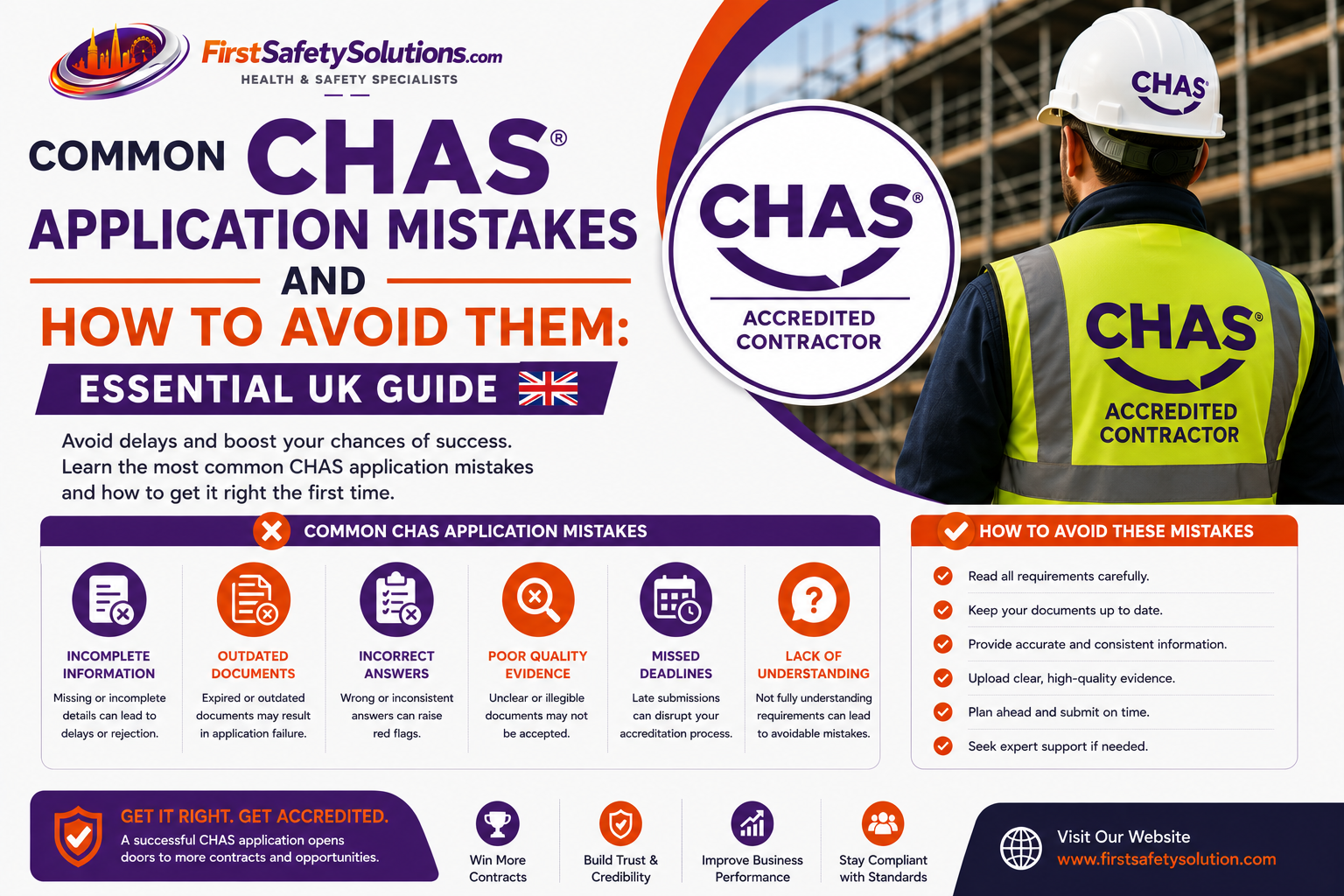
Common CHAS Application Mistakes and How to Avoid Them: Essential UK Guide
Applying for CHAS accreditation is an important step for contractors looking to demonstrate health and safety competence, improve credibility, and access more contract opportunities. However, many businesses underestimate the level of preparation required and end up facing delays, additional queries, or even rejection. Understanding Common CHAS Application Mistakes can significantly improve your chances of achieving approval on the first attempt. Whether you are a sole trader, a small contractor, or a large organisation, avoiding these mistakes can save time, reduce stress, and help your business maintain compliance with industry standards.
Many applications are unsuccessful not because businesses lack competence, but because documentation is incomplete, outdated, or incorrectly submitted. The good news is that most CHAS application issues are entirely preventable with proper preparation. In this comprehensive guide, we’ll explore the most frequent CHAS application mistakes, explain why they happen, and provide practical solutions to help contractors achieve successful accreditation.
What Is CHAS Accreditation?
CHAS (Contractors Health and Safety Assessment Scheme) is one of the UK’s leading health and safety accreditation providers.
Official CHAS website: https://www.chas.co.uk/
CHAS assesses contractors against recognized health and safety standards to verify their competence and compliance.
The assessment typically reviews:
- Health and safety policies
- Risk assessments
- Method statements
- Insurance documents
- Training records
- Accident reporting procedures
- Employee competency evidence
- Management systems
Successful accreditation demonstrates that a contractor meets recognized industry standards and is committed to safe working practices.
For application support: https://firstsafetysolution.com/accreditation/chas-accreditation-uk/
Why CHAS Applications Are Rejected
Before examining Common CHAS Application Mistakes, it is important to understand why applications fail.
Most rejections occur because:
- Required documents are missing
- Information is incomplete
- Policies are outdated
- Evidence is insufficient
- Insurance has expired
- Risk assessments are inadequate
In many cases, the contractor itself is capable and compliant, but the submitted evidence fails to demonstrate compliance effectively.
Mistake #1: Missing Health and Safety Policy
One of the most Common CHAS Application Mistakes is submitting an incomplete or missing health and safety policy. A health and safety policy forms the foundation of your application.
Common issues include:
- No written policy
- Unsigned policy
- Outdated document
- Generic templates with no company details
- Missing responsibilities
How to Avoid It
Ensure your policy:
- Reflects current operations
- Includes company details
- Is signed by management
- Is reviewed annually
- Covers relevant activities
A well-prepared policy demonstrates your commitment to health and safety management.
Mistake #2: Poor Quality Risk Assessments
Risk assessments are frequently scrutinised during CHAS assessments.
Many contractors submit:
- Generic assessments
- Incomplete documents
- Outdated assessments
- Assessments unrelated to actual work activities
This is one of the most costly Common CHAS Application Mistakes because assessors rely heavily on risk management evidence.
How to Avoid It
Your risk assessments should:
- Be activity-specific
- Identify hazards clearly
- Evaluate risks properly
- Include control measures
- Be reviewed regularly
High-quality risk assessments significantly improve approval prospects.
Mistake #3: Missing Method Statements
Method statements explain how work will be completed safely.
Common problems include:
- No method statements
- Generic templates
- Missing task details
- Failure to address identified risks
Many contractors focus on risk assessments while neglecting method statements entirely.
How to Avoid It
Prepare method statements that:
- Describe work activities clearly
- Align with risk assessments
- Explain control measures
- Include emergency procedures
- Reflect actual site operations
Mistake #4: Expired Insurance Documents
Insurance issues are among the most frequent Common CHAS Application Mistakes.
Contractors often submit:
- Expired policies
- Incorrect certificates
- Missing coverage details
- Unclear insurance evidence
Required insurance typically includes:
- Public liability insurance
- Employer’s liability insurance (where applicable)
How to Avoid It
Before submission:
- Verify policy dates
- Check coverage levels
- Ensure certificates are current
- Include all relevant documents
Accurate insurance records prevent unnecessary delays.
Mistake #5: Inadequate Training Records
Training demonstrates workforce competence.
Assessors often find:
- Missing records
- Expired certificates
- Incomplete training evidence
- Lack of refresher training
Without adequate evidence, businesses may struggle to demonstrate competency.
How to Avoid It
Maintain records of:
- Health and safety training
- CSCS cards
- Specialist certifications
- Toolbox talks
- Refresher courses
Keeping training records organised simplifies the assessment process.
Mistake #6: Incomplete Employee Competency Evidence
Competency extends beyond training certificates.
Assessors may request evidence relating to:
- Experience
- Qualifications
- Supervision arrangements
- Industry certifications
Many contractors underestimate this requirement.
How to Avoid It
Provide evidence of:
- Qualifications
- Experience records
- Training certificates
- Professional memberships
- Supervisor competencies
Mistake #7: Failing to Update Documentation
One of the most overlooked Common CHAS Application Mistakes is using outdated documents.
Examples include:
- Expired policies
- Old risk assessments
- Previous insurance certificates
- Outdated training records
How to Avoid It
Conduct a full document review before applying.
Create a checklist covering:
- Policy review dates
- Insurance expiry dates
- Training validity
- Assessment updates
Regular reviews help maintain compliance year-round.
Mistake #8: Submitting Generic Templates
Many businesses rely on downloadable templates without customizing them.
This often results in:
- Incorrect company names
- Irrelevant hazards
- Missing operational details
- Generic procedures
Assessors can quickly identify copied templates.
How to Avoid It
Ensure all documents:
- Reflect your business
- Match actual operations
- Include company branding
- Address genuine risks
Tailored documentation demonstrates professionalism.
Mistake #9: Ignoring Assessor Feedback
Some contractors receive assessor queries but fail to respond effectively.
Problems include:
- Delayed responses
- Incomplete answers
- Missing requested evidence
Ignoring feedback can delay approval significantly.
How to Avoid It
Respond promptly by:
- Addressing every query
- Providing requested documents
- Clarifying unclear information
- Meeting deadlines
Timely communication supports faster approval.
Mistake #10: Applying Without Preparation
Many businesses rush applications in order to meet tender deadlines.
This often creates multiple Common CHAS Application Mistakes simultaneously.
Consequences may include:
- Rejection
- Delays
- Additional administrative work
- Missed opportunities
How to Avoid It
Prepare in advance by:
- Reviewing requirements
- Gathering documentation
- Conducting internal audits
- Seeking professional guidance
Early preparation improves outcomes considerably.
CHAS Application Checklist
Before submitting your application, confirm you have:
✅ Health and safety policy
✅ Risk assessments
✅ Method statements
✅ Insurance certificates
✅ Training records
✅ Competency evidence
✅ Accident procedures
✅ Equipment inspection records
✅ Emergency arrangements
✅ Current company information
Using a checklist reduces the likelihood of errors.
How Professional Support Can Help
Many contractors choose professional assistance to avoid Common CHAS Application Mistakes.
Benefits include:
- Expert guidance
- Document reviews
- Policy preparation
- Compliance checks
- Faster application completion
- Reduced rejection risk
Professional support often saves significant time and effort.
How First Safety Solution Can Help
First Safety Solution supports contractors throughout the CHAS accreditation process.
Services include:
- Application assistance
- Health and safety documentation
- Risk assessments
- Compliance reviews
- Accreditation support
Useful resources:
CHAS Accreditation:
https://firstsafetysolution.com/accreditation/chas-accreditation-uk/
CHAS Assist UK:
https://firstsafetysolution.com/shop/chas-assist-uk/
Accreditation Hub:
https://firstsafetysolution.com/accreditation/
Expert support can help businesses avoid costly mistakes and improve approval success rates.
Why CHAS Applications Are Becoming More Important in 2026
As procurement standards continue to evolve, more organisations are requiring contractors to demonstrate health and safety competence before being allowed to tender for work. This trend has increased demand for CHAS accreditation across construction, engineering, facilities management, maintenance, and specialist trades. Many contractors first encounter the accreditation requirement when bidding for public sector projects, local authority contracts, housing association work, or large commercial developments. As a result, avoiding Common CHAS Application Mistakes has become more important than ever.
In 2026, clients are paying closer attention to contractor compliance, risk management, and workforce competence. Businesses that fail to meet these standards may find themselves excluded from tender opportunities. By understanding the most frequent Common CHAS Application Mistakes, contractors can improve approval success rates and strengthen their competitive position within the marketplace.
How CHAS Assessors Review Your Application
Many applicants assume assessors only review health and safety policies. In reality, the assessment process is much more comprehensive.
Assessors typically evaluate:
- Health and safety management systems
- Risk assessments
- Method statements
- Insurance arrangements
- Training records
- Competency evidence
- Accident reporting procedures
- Equipment inspection records
- Emergency arrangements
One reason Common CHAS Application Mistakes occur is because businesses underestimate the amount of evidence required. Assessors are looking for proof that health and safety procedures are not only documented but also implemented effectively throughout the organization. The stronger and more organized your evidence, the smoother the assessment process is likely to be.
The Financial Impact of CHAS Application Delays
Many contractors focus solely on obtaining accreditation and overlook the financial consequences of delays.
Some of the most expensive Common CHAS Application Mistakes can result in:
- Missed tender deadlines
- Lost contract opportunities
- Delayed project starts
- Additional administration costs
- Increased consultancy expenses
For example, a contractor bidding for a major project may lose the opportunity entirely if accreditation is not approved before the procurement deadline. This is why preparation should begin well before accreditation is required. The cost of delay often exceeds the cost of obtaining accreditation itself.
How Small Contractors Can Avoid Common CHAS Application Mistakes
Small businesses often face unique challenges during the accreditation process.
Common difficulties include:
- Limited administrative resources
- Lack of dedicated health and safety personnel
- Incomplete documentation
- Limited understanding of assessment requirements
Fortunately, these challenges can be overcome through planning and organization.
Small contractors should:
- Maintain digital document folders
- Schedule annual policy reviews
- Track insurance expiry dates
- Keep training records updated
- Review risk assessments regularly
Following these practices can help minimise Common CHAS Application Mistakes and improve compliance standards.
How Larger Businesses Can Avoid Common CHAS Application Mistakes
Larger organizations often experience different challenges.
These may include:
- Multiple departments
- Larger workforces
- Complex operations
- Numerous subcontractors
- Extensive documentation requirements
In larger businesses, Common CHAS Application Mistakes frequently arise because documents are stored in different locations or managed by different departments.
Best practice includes:
- Centralised document management
- Internal compliance audits
- Scheduled policy reviews
- Regular training updates
- Dedicated compliance responsibilities
A structured approach helps ensure documentation remains accurate and accessible.
The Role of Health and Safety Documentation
Documentation plays a central role in CHAS assessments.
Many Common CHAS Application Mistakes stem from poor record management rather than actual safety deficiencies.
Important documents include:
| Document | Purpose |
|---|---|
| Health and Safety Policy | Demonstrates commitment to safety |
| Risk Assessments | Identifies workplace hazards |
| Method Statements | Explains safe working procedures |
| Insurance Certificates | Confirms required cover |
| Training Records | Demonstrates competency |
| Accident Procedures | Shows incident management processes |
| Inspection Records | Verifies equipment safety |
Maintaining accurate records throughout the year makes accreditation significantly easier.
Benefits of Getting Your CHAS Application Right First Time
Avoiding Common CHAS Application Mistakes offers several important advantages.
These include:
Faster Approval
Well-prepared applications are typically processed more efficiently.
Reduced Administrative Work
Fewer assessor queries mean less time gathering additional information.
Improved Tender Opportunities
Accreditation can help businesses qualify for more contracts.
Better Compliance Management
Preparing for assessment often improves internal safety systems.
Increased Client Confidence
Accredited contractors are often viewed as lower-risk suppliers.
These benefits demonstrate why preparation should never be rushed.
Creating a CHAS Preparation Timeline
One of the best ways to avoid Common CHAS Application Mistakes is to create a preparation timeline.
Three Months Before Applying
- Review health and safety policy
- Update risk assessments
- Check insurance documents
- Review training records
Two Months Before Applying
- Complete documentation updates
- Conduct internal audits
- Gather competency evidence
One Month Before Applying
- Review all paperwork
- Address compliance gaps
- Prepare submission documents
Application Week
- Perform final checks
- Verify document versions
- Confirm all evidence is included
A structured timeline dramatically reduces the risk of missing critical information.
Frequently Asked Questions
What is the most common CHAS application mistake?
Missing or incomplete health and safety documentation is one of the most common issues.
Can generic templates cause rejection?
Yes. Generic templates that do not reflect actual business activities may lead to assessor concerns.
Do risk assessments need to be updated?
Yes. Risk assessments should be reviewed regularly and updated when circumstances change.
Can expired insurance documents affect approval?
Absolutely. Current insurance evidence is a key assessment requirement.
How long does CHAS approval take?
Times vary depending on application quality and assessor workload.
Is professional support necessary?
No, but many contractors use professional assistance to improve efficiency and reduce rejection risks.
Can sole traders apply for CHAS?
Yes. Sole traders can apply provided they meet the relevant requirements.
How can I improve my chances of approval?
Prepare thoroughly, maintain accurate documentation, and avoid the Common CHAS Application Mistakes discussed in this guide.
Conclusion
Understanding and avoiding Common CHAS Application Mistakes is essential for contractors seeking successful accreditation. Most application problems stem from incomplete documentation, outdated records, poor preparation, or failure to provide sufficient evidence.
By maintaining accurate policies, current insurance, detailed risk assessments, and comprehensive training records, businesses can significantly improve their chances of approval. Taking time to prepare properly not only reduces delays but also demonstrates a genuine commitment to health and safety compliance.
For contractors seeking expert guidance, First Safety Solution offers comprehensive support to help navigate the accreditation process and achieve CHAS approval with confidence.
🔗 Learn more or book at firstsafetysolution.com
📞 Call Now: 02034888123 | 07501170101
📍 Visit Us: Quantum Offices, Mountview House, 212 High Rd, Ilford IG1 1QB