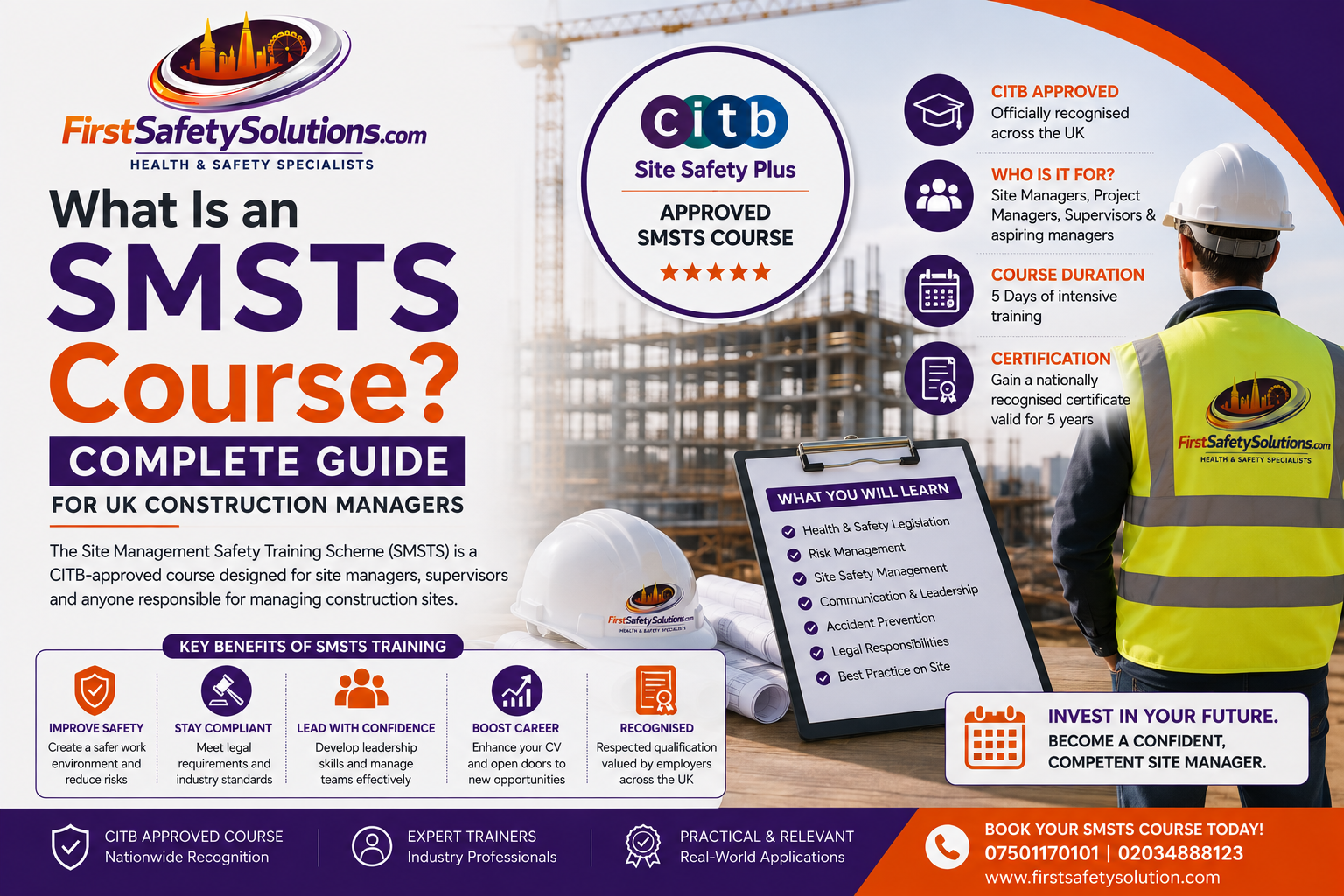
What Is an SMSTS Course? Complete Guide for UK Construction Managers
Managing a construction site comes with serious responsibilities. A site manager needs to coordinate workers, subcontractors, materials, equipment, and deadlines while making sure work is planned and carried out safely. This is where the SMSTS course can play an important role.
SMSTS stands for Site Management Safety Training Scheme. It is a CITB Site Safety Plus course designed for people who already have, or are preparing to take on, significant responsibilities for managing construction sites.
The course covers important areas including health and safety legislation, the Construction (Design and Management) Regulations 2015, risk assessments, method statements, site hazards, occupational health, and environmental issues. CITB describes it as a five-day course focused on helping managers plan, organize, monitor, control, and administer construction activities safely. For construction professionals considering a management role, understanding what SMSTS involves can help you decide whether the training is right for you.
In this guide, we explain what an SMSTS course is, who should take it, what you learn, how the training works, how it differs from SSSTS, and why it can be valuable for UK construction managers.
What Does SMSTS Stand For?
SMSTS stands for Site Management Safety Training Scheme. It is part of the CITB Site Safety Plus training program and focuses on health, safety, welfare, and environmental management within construction. You can learn more about the official course through CITB’s SMSTS course information.
The course is intended for people who have, or are about to take on, responsibility for planning, organizing, monitoring, controlling, and administering groups of staff in a construction environment. Unlike basic health and safety awareness training, SMSTS focuses on the responsibilities of people managing construction activities. That means the training is particularly relevant when your role involves making decisions that affect other workers, subcontractors, and the wider project.
Why Is SMSTS Important for Construction Managers?
Construction managers have to make decisions throughout the working day. A project can involve multiple contractors, changing site conditions, tight deadlines, and different types of work happening at the same time. A manager needs to understand how to plan and control these activities without compromising health and safety.
The SMSTS course helps develop knowledge around:
- Legal responsibilities
- Health and safety management
- Risk assessment
- Method statements
- Site hazards
- Worker welfare
- Occupational health
- Environmental considerations
- Communication
- Safety leadership
- Monitoring and control
CITB states that the course aims to help site managers manage health, safety, and environmental aspects in accordance with current legal provisions and understand their responsibilities for site health, safety, welfare, and the environment. This makes the course relevant not only to safety compliance but also to effective day-to-day site management.
Who Should Take an SMSTS Course?
SMSTS is primarily designed for people with significant site management responsibilities.
You may want to consider the course if you are already working as:
- Site manager
- Construction manager
- Project manager
- Contracts manager
- Site agent
- Senior supervisor moving into management
- Construction professional preparing for a management position
CITB says there are no formal entry requirements, although delegates should hold or be about to hold a site manager role. Previous health and safety knowledge is recommended. This means you do not necessarily need to have completed a particular qualification before taking SMSTS. However, you should have enough experience and understanding to participate effectively in training at the site-management level.
What Does an SMSTS Course Cover?
The course covers a broad range of subjects that construction managers need to understand. Rather than focusing on one individual hazard, the training looks at how health and safety can be managed across a construction project.
Health and Safety Law
Understanding the legal framework is an important part of construction management. Managers need to know how legislation affects their responsibilities and the way work should be planned and controlled. The course covers relevant health and safety legislation and helps delegates understand the responsibilities associated with managing construction activities. This knowledge can help managers make more informed decisions when dealing with workers, subcontractors, and project teams.
Construction (Design and Management) Regulations
The Construction (Design and Management) Regulations 2015, commonly called CDM, are an important part of construction health and safety in Great Britain. Managers need to understand how CDM affects the planning and management of construction work. The SMSTS course includes CDM as part of its legal and management content. The Health and Safety Executive also explains that construction duty holders have responsibilities for planning, managing, and monitoring construction work so that it is carried out without risks to health and safety. For managers, understanding these responsibilities is essential.
Risk Assessments and Method Statements
Risk assessment is one of the most important parts of construction safety management. Managers need to understand how hazards are identified and how appropriate controls are selected.
For example, a project may involve:
- Working at height
- Excavation
- Lifting operations
- Plant and machinery
- Electrical work
- Hazardous substances
- Confined spaces
A manager needs to consider how these risks will be controlled before and during the work. The SMSTS course covers risk assessments and method statements as part of its learning outcomes.
Site Hazards
Construction sites can change quickly. New workers may arrive, work areas can change, and several different activities may take place simultaneously. The course covers the management of common construction hazards, helping delegates understand how risks can be identified, controlled, and monitored. CITB’s course information specifically includes areas such as electricity, excavations, working at height, scaffolding, demolition, and confined spaces.
Occupational Health
Construction safety is not only about preventing accidents. Managers also need to consider risks that can affect workers’ health over time.
These can include exposure to:
- Dust
- Noise
- Vibration
- Hazardous substances
- Manual handling
- Repetitive activities
Understanding occupational health helps managers take a broader approach to protecting workers.
Environmental Issues
Construction projects can have environmental impacts as well.
Managers may need to consider:
- Waste
- Pollution
- Dust
- Noise
- Fuel storage
- Materials
- Site conditions
Environmental management is included within the SMSTS course, giving delegates a broader understanding of responsible construction management.
How Long Is an SMSTS Course?
The standard SMSTS course lasts five days. CITB specifies 37.5 hours of required attendance for the full course. The training is normally delivered over five days, although CITB scheme rules also allow certain alternative delivery arrangements while maintaining the required learning hours and continuity. For most learners, the five-day format provides an opportunity to explore management responsibilities in considerably more depth than a short safety course.
What Happens During the Five Days?
The exact structure can vary between approved training providers, but the course is designed to be interactive. CITB describes learning activities that can include discussions, case studies, group work, presentations, and exercises.
You may therefore spend time:
- Learning key legal principles
- Discussing construction scenarios
- Reviewing safety problems
- Working through exercises
- Considering management decisions
- Applying safety principles to site situations
This practical approach can help managers connect the course content with situations they may encounter at work.
Is There an Assessment?
Yes.
Successful completion requires delegates to meet the course assessment requirements. CITB course information states that students must attend the required hours and pass a multiple-choice test. This means attendance alone is not the only consideration. It is important to participate throughout the course and take time to understand the material.
How Long Is the SMSTS Certificate Valid?
An SMSTS certificate is valid for five years. CITB states that to remain certified, delegates need to retake the course or complete the SMSTS Refresher before the certificate expires. Keeping track of the expiry date is important for construction professionals whose employers or clients require current SMSTS certification.
SMSTS vs SSSTS: What Is the Difference?
SMSTS and SSSTS are often confused because both are CITB Site Safety Plus courses. However, they are designed for different levels of responsibility.
SSSTS means Site Supervisors’ Safety Training Scheme.
SMSTS means Site Management Safety Training Scheme.
The main difference is the level of responsibility associated with the role.
| SMSTS | SSSTS |
|---|---|
| Designed for site managers and management-level roles | Designed for site supervisors |
| Five-day course | Two-day course |
| Focuses on managing health and safety | Focuses on supervising health and safety |
| Suitable for broader site management responsibilities | Suitable for supervisory responsibilities |
CITB recommends SSSTS for people without previous health and safety management experience who are not yet working at the level required for SMSTS. If you are unsure which course is appropriate, consider your current responsibilities and the role you are preparing to take on.
Is SMSTS a Legal Requirement?
Completing an SMSTS course is not, by itself, a universal legal requirement for every construction manager. However, employers, principal contractors, and clients may require managers to hold recognized training as part of their competence requirements. The important point is that construction businesses must have suitable arrangements for managing health and safety. The Health and Safety Executive explains that construction work needs to be planned, managed, and monitored appropriately, with responsibilities allocated to the relevant duty holders. SMSTS can help managers develop knowledge that supports these responsibilities.
What Are the Benefits of Taking an SMSTS Course?
There are several potential benefits for construction professionals.
Stronger Understanding of Safety Responsibilities
Managers need to understand how their decisions can affect workers and project safety. SMSTS provides structured training around these responsibilities.
Better Risk Management
Understanding how to assess and control risks can help managers approach construction activities more systematically.
Improved Safety Leadership
Managers play an important role in setting expectations on site. Good leadership can encourage workers and subcontractors to take safety procedures seriously.
Support for Career Development
For construction professionals moving towards management, SMSTS can complement practical experience and demonstrate commitment to professional development.
Better Understanding of Construction Legislation
The course covers important legal and regulatory areas relevant to construction management. This can help managers understand why certain procedures and controls are necessary.
Stronger Site Management
Health and safety is closely connected with planning, communication, and organization. A well-managed site can benefit from clear responsibilities, effective communication, and appropriate risk controls.
How Can SMSTS Training Help With Day-to-Day Management?
The value of training comes from applying what you learn.
A site manager might use their knowledge when:
- Reviewing a risk assessment
- Checking a method statement
- Planning site activities
- Coordinating subcontractors
- Managing site inductions
- Reviewing incidents
- Monitoring safety performance
- Communicating safety expectations
For example, if several contractors need to work in the same area, the manager needs to consider how their activities could affect one another. This involves planning, communication, and monitoring rather than simply telling workers to “work safely.”
Why Choose a Five-Day Course?
Five days provides time to explore construction management responsibilities in detail. CITB describes the SMSTS course as covering five broad learning areas, including legal and management, health and welfare, general safety, high-risk activities, and environment. This gives the course a wider scope than short introductory safety training. It is designed to help managers understand how different parts of construction safety fit together.
How to Prepare for an SMSTS Course
You do not need to memorize construction legislation before attending. However, preparation can help you get more from the training.
Before your course, think about:
- Your current management responsibilities
- Common hazards on your sites
- How risk assessments are currently managed
- How subcontractors are coordinated
- How incidents are reported
- How workers receive safety information
- What safety challenges you regularly face
Bringing real workplace experience into discussions can make the course more relevant and easier to understand.
Where Can You Book an SMSTS Course?
If you are looking for SMSTS training through First Safety Solution, you can explore the dedicated course information page: SMSTS Course – First Safety Solution
You can also view the available SMSTS course booking option: Book an SMSTS Course
These pages can be useful starting points if you want to check course information before booking.
Who Should Consider Booking SMSTS?
SMSTS may be worth considering if you are:
- Already working as a site manager
- Moving into site management
- Working as a construction manager
- Managing subcontractors
- Responsible for planning construction activities
- Taking on greater health and safety responsibility
- Developing your construction management career
The course is particularly relevant when your responsibilities extend beyond supervising individual tasks and involve managing wider site operations.
Frequently Asked Questions
What is an SMSTS course?
SMSTS stands for Site Management Safety Training Scheme. It is a CITB Site Safety Plus course designed for people who have, or are preparing to take on, significant responsibility for managing construction activities.
How many days is SMSTS?
The standard SMSTS course is five days, with 37.5 hours of required attendance under CITB’s scheme requirements.
Who needs SMSTS?
It is aimed at people such as site managers, construction managers, project managers, and others responsible for planning, organizing, monitoring, and controlling construction activities.
Is SMSTS harder than SSSTS?
SMSTS is a longer management-level course, while SSSTS is designed for supervisors. The courses have different purposes, so the better choice depends on your responsibilities rather than simply which course is “harder.”
Does SMSTS expire?
Yes. CITB states that SMSTS certification is valid for five years. You need to complete the appropriate refresher before expiry or retake the full course.
Is there an exam for SMSTS?
The course includes an assessment, including a multiple-choice test.
Can I take SMSTS online?
CITB states that SMSTS can be delivered in a classroom or through remote delivery, depending on the course and approved provider.
Where can I find SMSTS training?
You can view First Safety Solution’s SMSTS course information here: View SMSTS Course Information
You can also check the booking page: Book SMSTS training.
Final Thoughts
An SMSTS course is designed to help construction managers understand the responsibilities involved in planning, organizing, monitoring, and controlling health and safety on construction sites. It is a five-day CITB Site Safety Plus course covering important areas such as legislation, CDM, risk assessment, method statements, site hazards, occupational health, and environmental management.
For someone already working in site management, the course can strengthen existing knowledge. For someone preparing to move into management, it can provide useful structured training alongside practical construction experience. The key is to choose training that matches your responsibilities.