SSSTS Course: 7 Essential Facts Every UK Site Supervisor Should Know
Working as a construction site supervisor involves much more than checking whether work is being completed on time. Supervisors have an important role in coordinating workers, monitoring site activities, communicating safety requirements, and responding to requirements and practices that are identified. This is why appropriate supervision training is important. You can also explore the wider range of CITB Courses available from First Safety Solution to find training that matches your construction role.
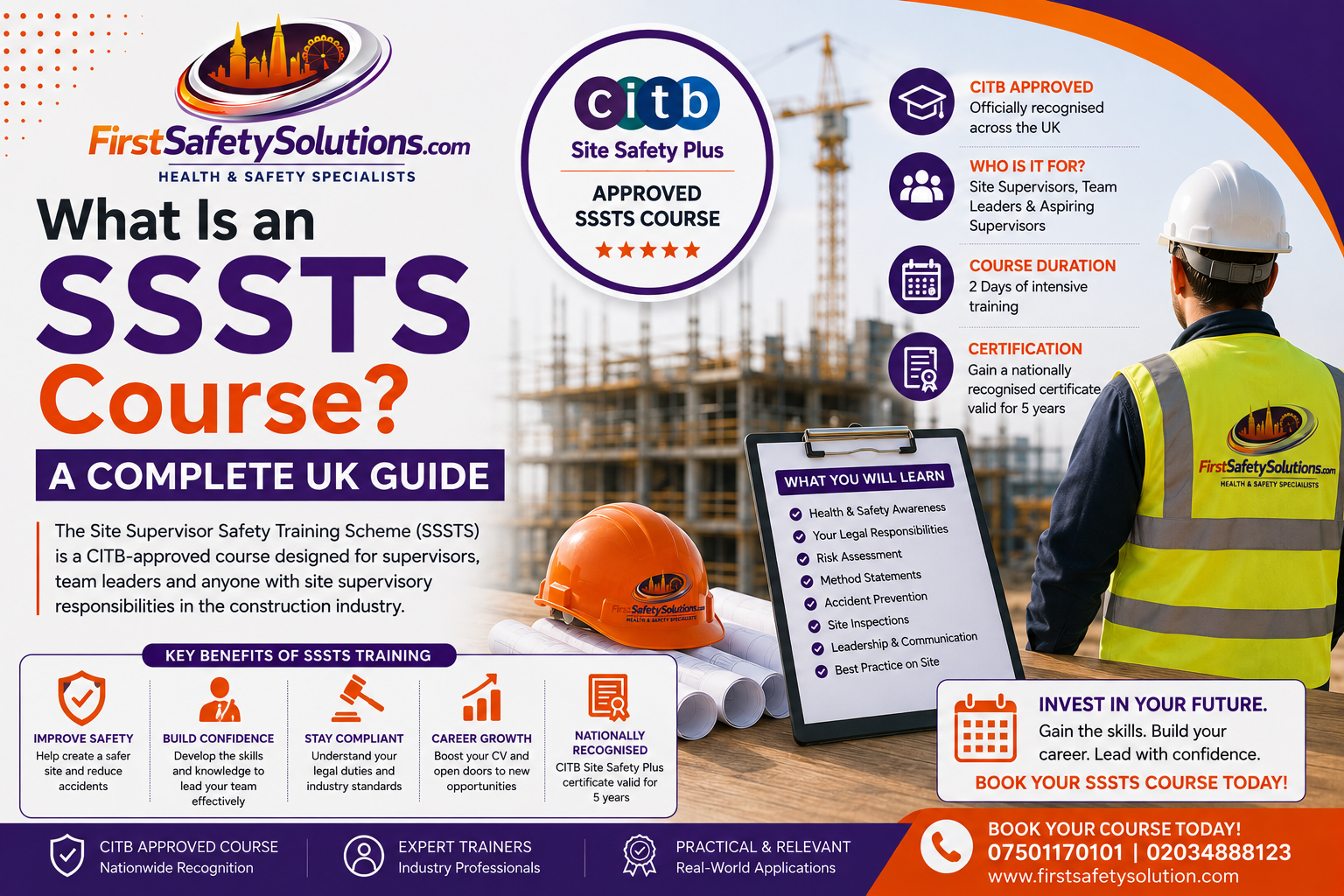
The SSSTS course, which stands for Site Supervision Safety Training Scheme, is a CITB Site Safety Plus course designed for people who have, or are about to take on, supervisory responsibilities in construction. CITB describes SSSTS Course as a two-day course covering relevant legislation, risk assessment, control measures, and communication, with the aim of helping supervisors manage risks and support a positive health and safety culture.
For someone moving into a supervisory position, the course can provide useful knowledge about the responsibilities that come with overseeing construction work. This guide explains what an SSSTS Course is, who it is designed for, what you learn, how long it takes, how assessment works, how long the certificate lasts and how SSSTS Course compares with SMSTS.
What Does SSSTS Stand For?
SSSTS stands for Site Supervision Safety Training Scheme.
It is part of CITB’s Site Safety Plus suite of construction training courses. The course is specifically aimed at people who have, or are about to have, supervisory responsibilities on construction sites. CITB states that there are no formal entry requirements, although delegates should hold or be about to hold a site supervisor role and previous health and safety knowledge is recommended.
You can read the current course information directly from CITB’s official SSSTS course page.
The purpose of the course is not simply to give supervisors another certificate. It is designed to help them understand their responsibilities and apply health and safety principles when supervising construction activities.
Why Is an SSSTS Course Important?
A supervisor is often the person closest to workers and day-to-day activities on a construction site. That means supervisors can have an important influence on whether safe working practices are followed.
A supervisor may need to:
- Monitor workers
- Communicate site rules
- Deliver toolbox talks
- Support site inductions
- Check that work follows agreed procedures
- Identify unsafe practices
- Report hazards
- Encourage workers to raise concerns
- Monitor changing site conditions
- Intervene when unsafe behaviour is identified
CITB says SSSTS Course aims to help supervisors understand health and safety law, their supervisory responsibilities, risk assessments, method statements, site inductions, toolbox talks, and effective monitoring of site activities. This makes the training relevant to the practical responsibilities supervisors deal with every day.
Who Should Take an SSSTS Course?
The SSSTS Course is intended for people who have, or are preparing to take on, supervisory responsibilities.
This can include:
- Site supervisors
- Assistant supervisors
- Working supervisors
- Team leaders
- Experienced tradespeople moving into supervision
- Construction professionals preparing for supervisory duties
- Front-line construction managers
You do not necessarily need to have been a supervisor for years before taking the course. In fact, it can be particularly useful for someone preparing to take on their first supervisory position.
Experienced Workers Moving Into Supervision
Moving from an operative role into supervision can be a significant career step. An experienced worker may understand their trade extremely well but still need to develop additional skills for managing other people and monitoring site safety. The responsibilities become broader.
Instead of focusing only on your own work, you may need to think about:
- Other workers
- Subcontractors
- Work sequencing
- Site rules
- Risk controls
- Communication
- Welfare
- Safety procedures
An SSSTS course can help bridge that gap between practical experience and supervisory responsibility.
What Does an SSSTS Course Cover?
The course covers several areas that are relevant to construction supervision. CITB identifies areas including health and safety law, supervisory responsibilities, risk assessments, method statements, inductions, toolbox talks, site monitoring, and intervention when poor practices are identified. The content is designed to give supervisors a practical understanding of their role.
Let’s look at some of the key areas.
Health and Safety Law
Construction supervisors need to understand the basic legal framework that applies to their work. You do not need to become a health and safety lawyer, but you should understand why certain procedures are required and what your responsibilities are. This can help you make better decisions when supervising work.
A supervisor may need to recognize when:
- Work is not being carried out safely
- A control measure is missing
- Workers are not following procedures
- Additional information is required
- Work should be paused and reviewed
Understanding the principles behind health and safety law can help supervisors respond appropriately.
Risk Assessments
Risk assessment is an essential part of construction safety. A supervisor should understand how risks are identified and how control measures are used to reduce those risks. For example, imagine workers are carrying out activities at height.
A supervisor may need to consider the following:
- Where the work is taking place
- What access equipment is being used
- Whether workers are competent
- What could cause a fall
- What protective measures are required
- Whether conditions have changed
The SSSTS course helps supervisors understand the importance of risk assessment and applying suitable controls.
Method Statements
Method statements explain how particular work should be carried out safely. Supervisors may need to brief workers on method statements and check that the agreed method is being followed.
For example, a method statement could relate to:
- Excavation
- Lifting operations
- Working at height
- Demolition
- Plant operation
- Electrical work
- Installation activities
A supervisor needs to recognize when the actual work differs from the planned method. If circumstances change, the work may need to be reviewed before continuing.
Site Inductions
Site inductions help workers and visitors understand important information before they begin work.
Depending on the project, an induction may cover the following:
- Site rules
- Emergency procedures
- Welfare facilities
- Restricted areas
- Traffic routes
- PPE requirements
- Reporting procedures
- Specific site hazards
Supervisors can play an important role in ensuring that workers understand the information relevant to their activities.
Toolbox Talks
Toolbox talks are commonly used to communicate specific safety information to workers. A good toolbox talk should be relevant to the work being undertaken.
Topics might include:
- Working at height
- Manual handling
- PPE
- Dust
- Noise
- Excavation safety
- Plant movements
- Electrical safety
- Housekeeping
CITB specifically identifies effective toolbox talks as part of the SSSTS Course learning content.
Monitoring Site Activities
Supervision is not simply about giving instructions. Supervisors also need to monitor what is happening. This means checking whether workers are actually following the agreed procedures. For example, if workers have been briefed on a particular safe system of work, the supervisor should monitor the activity rather than assuming everything is being done correctly. Regular monitoring can help identify problems early.
Intervening When Unsafe Work Is Identified
One of the most important responsibilities of a supervisor is knowing when to intervene. If unsafe behavior or a dangerous condition is identified, ignoring it can allow the problem to become more serious.
Supervisors should be prepared to:
- Identify the problem.
- Stop or control the unsafe activity where necessary.
- Communicate with the people involved.
- Establish what went wrong.
- Check the relevant controls.
- Escalate the issue when appropriate.
- Allow work to continue only when suitable arrangements are in place.
CITB specifically highlights the importance of timely intervention when bad practice is identified.
How Long Is an SSSTS Course?
The standard SSSTS course is two days. CITB describes it as a two-day Site Safety Plus course for site supervisors. The course requires full attendance for the required training hours. The current CITB scheme information specifies 15 hours for the two-day course. This makes the SSSTS course considerably shorter than the SMSTS, which is designed for broader site-management responsibilities. For supervisors who need recognized training without committing to a five-day management course, SSSTS course can therefore be a more appropriate option.
What Happens During the Two Days?
The exact timetable can vary between approved providers, but the course is designed to involve active learning rather than simply listening to a presentation.
Training can include the following:
- Tutor-led sessions
- Group discussions
- Case studies
- Presentations
- Practical exercises
- Questions and answers
- Safety scenarios
- Assessment activities
CITB’s course information describes group work, discussions, case studies, and presentations as part of the learning experience. This approach gives delegates opportunities to think about how safety principles apply to real construction situations.
Is There an Exam for SSSTS?
Yes.
Delegates must successfully complete the course requirements and pass the end-of-course examination to receive their certificate. The current CITB scheme rules state that the examination is compulsory and consists of 25 questions, with a pass mark of 80% (24 out of 30 marks). It includes multiple-choice and short written questions, including safety-critical questions.
The examination lasts 30 minutes. Delegates should therefore pay attention throughout the course and make sure they understand the key concepts rather than trying to memorize information at the last minute.
What Happens If You Do Not Pass the Exam?
If a delegate does not initially achieve the required result, CITB’s current scheme rules provide circumstances in which a resit may be available. The exact arrangements depend on the result and the applicable scheme rules. This is another reason to take the training seriously from the beginning. Ask questions during the course, participate in discussions, and make sure you understand the topics being covered.
How Long Is an SSSTS Certificate Valid?
An SSSTS certificate is valid for five years. CITB states that to remain certified, delegates need to retake the SSSTS Course or complete the SSSTS Refresher before their certificate expires. It is important to keep track of your certificate expiry date. Leaving refresher training until after the certificate has expired can create unnecessary problems, particularly if your employer or client requires current certification.
What Is the SSSTS Refresher Course?
The SSSTS Refresher is designed for people who already hold SSSTS certification and need to maintain it. CITB lists the SSSTS Refresher as a one-day course. The refresher allows supervisors to update their knowledge rather than completing the full two-day course again, provided they meet the relevant requirements. Plan your refresher before the original certificate expires.
SSSTS vs SMSTS: What Is the Difference?
One of the most common questions construction professionals ask is whether they should take SSSTS or SMSTS. Although both are CITB Site Safety Plus courses, they are aimed at different levels of responsibility.
SSSTS
SSSTS is primarily designed for supervisors. It focuses on supervising health and safety, communicating requirements, monitoring activities, and intervening when unsafe practices are identified.
SMSTS
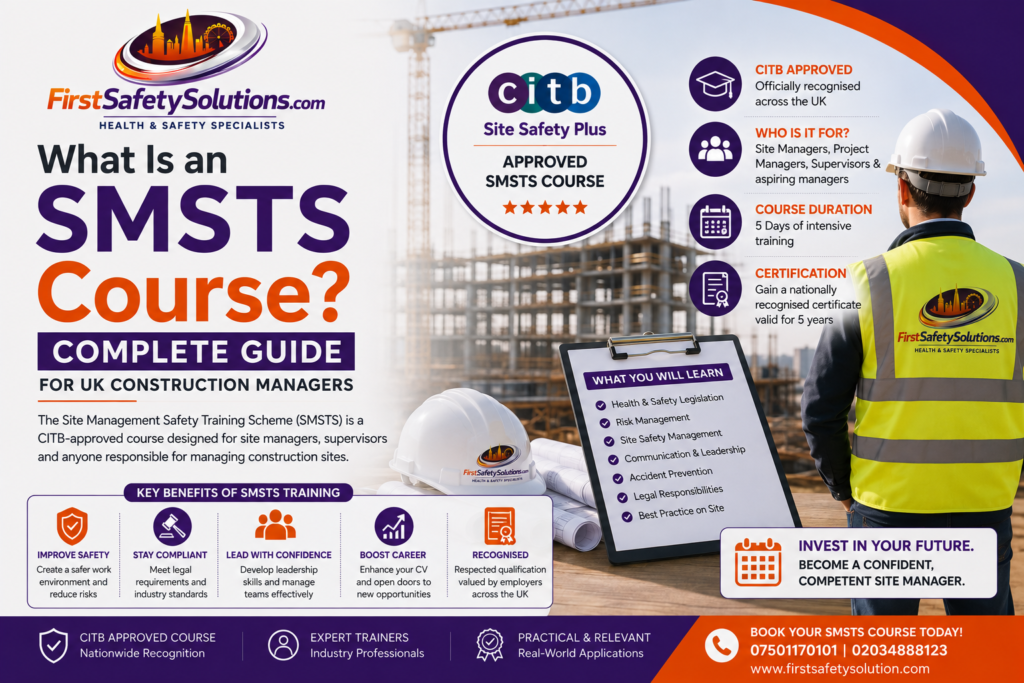
SMSTS is aimed at people with broader site-management responsibilities. CITB describes SMSTS as a five-day course covering management-level responsibilities, including legal requirements, CDM, risk assessment, site setup, hazards, occupational health, and environmental issues.
The basic difference can be summarized as:
| SSSTS | SMSTS |
|---|---|
| Site supervision | Site management |
| 2 days | 5 days |
| Supervisor-level responsibilities | Management-level responsibilities |
| Monitoring and supervising work | Planning, organizing, and controlling wider site activities |
| Suitable for site supervisors | Suitable for site managers and management roles |
If your role is supervisory, SSSTS course may be the more appropriate course. If you are responsible for broader site management, SMSTS may be more suitable. If you are moving from site supervision into management, you may also want to explore the SMSTS Course for broader site-management responsibilities.
Is SSSTS a Legal Requirement?
SSSTS itself is not a universal legal requirement for every construction supervisor. However, employers, contractors, and clients may require supervisors to hold recognized training as part of their competence arrangements. The important issue is that construction work must be properly planned, managed, and supervised. Training can support a supervisor’s competence, but it should be considered alongside practical experience, company procedures, risk assessments, communication, and other safety arrangements. Therefore, always check what your employer, client, or principal contractor requires for your particular role.
Why Is SSSTS Course Useful for Construction Supervisors?
An SSSTS course can help supervisors develop knowledge that can be applied directly to their work.
Better Understanding of Responsibilities
A supervisor needs to know what is expected of them.
Training can help clarify the relationship between the following:
- Site management
- Supervisors
- Workers
- Contractors
- Subcontractors
This can make communication and escalation clearer.
Improved Risk Awareness
Supervisors are often in a strong position to identify problems because they are close to day-to-day work. Understanding risk assessment can help them recognize hazards before they result in an incident.
Stronger Communication
Supervisors regularly communicate with workers. They may deliver briefings, explain procedures, and discuss safety concerns. Good communication can make safety information easier to understand and follow.
Better Site Monitoring
Supervisors should not assume that a safe system is being followed simply because workers were briefed on it. Regular monitoring can identify problems early.
Support for Career Progression
SSSTS Course can also form part of a construction professional’s development. Someone who begins as an operative may progress into supervision and later move into site management. CITB identifies SMSTS as a natural progression from SSSTS for those moving towards management responsibilities.
How Can an SSSTS Course Help a New Supervisor?
Starting a supervisory role can feel very different from working as an operative. You may suddenly become responsible for monitoring people you previously worked alongside. This can create difficult situations. For example, you may have to tell an experienced worker that a particular task is not being carried out safely. A good supervisor needs confidence to intervene professionally.
The SSSTS Course can help develop an understanding of how supervisors should approach responsibilities involving the following:
- Leadership
- Communication
- Risk control
- Monitoring
- Worker engagement
- Safety procedures
The goal is not to make supervisors unnecessarily strict.
It is to help them understand how effective supervision contributes to a safer and more organized site.
The Role of Communication in Site Supervision
Communication is one of the most important parts of supervision.
A supervisor may need to communicate with:
- Workers
- Site managers
- Subcontractors
- Delivery drivers
- Plant operators
- Visitors
- Other supervisors
Instructions should be clear and appropriate to the work being carried out. If workers do not understand what is expected, even a well-designed safety procedure may not be effective. Good communication also means listening. Workers may identify practical problems that management has not noticed. Encouraging workers to raise concerns can therefore contribute to a stronger safety culture.
How to Prepare for an SSSTS Course
You do not need to know everything before attending. However, some preparation can help you get more from the two days. Before the course, think about the types of work you supervise.
Consider:
- What are the most common hazards?
- How are risk assessments communicated?
- How are toolbox talks delivered?
- How are new workers inducted?
- What happens when unsafe work is identified?
- How are subcontractors monitored?
- How are incidents reported?
If you already work in construction, thinking about real examples can make the course content easier to relate to.
What Should You Check Before Booking?
Before booking an SSSTS course, check the course information carefully.
Consider:
- Course provider
- Course dates
- Delivery format
- Location
- Course duration
- Assessment arrangements
- Certification
- Booking terms
- Whether the course meets your employer’s requirements
CITB states that SSSTS can be taken in a classroom or through remote delivery. Always check the specific course details before booking.
Where Can You Find SSSTS Training?
If you are looking for SSSTS training through First Safety Solution, you can use the company’s CITB course information to explore the available training options. First Safety Solution focuses on construction health and safety training and consultancy for UK businesses. When choosing your course, make sure you select training that matches your current responsibilities.
Frequently Asked Questions About SSSTS Course
What is an SSSTS course?
SSSTS stands for Site Supervision Safety Training Scheme. It is a CITB Site Safety Plus course designed for people who have, or are preparing to take on, supervisory responsibilities in construction.
How long is SSSTS?
The standard SSSTS course lasts two days, with 15 hours of required attendance under the applicable CITB scheme requirements.
Who should take SSSTS Course?
It is designed for construction professionals who have, or are about to have, site supervisory responsibilities.
Is SSSTS harder than SMSTS?
The two courses have different purposes. SSSTS is aimed at supervisors, while SMSTS is aimed at people with broader management responsibilities. SMSTS is also longer at five days.
Does SSSTS expire?
Yes. CITB states that SSSTS certification is valid for five years. You should complete the SSSTS Refresher or retake the course before your certificate expires.
Is there an SSSTS exam?
Yes. The course includes a compulsory end-of-course examination. The current CITB scheme rules specify a pass mark of 80%.
Can I take SSSTS online?
CITB states that SSSTS can be delivered in a classroom or via remote delivery.
Can SSSTS help with career progression?
Yes. SSSTS can support professionals moving into site supervision. For those who later take on broader management responsibilities, SMSTS can be a natural progression.
Should a site manager take SSSTS or SMSTS?
Someone with significant site-management responsibilities will generally need to consider SMSTS, while SSSTS Course is designed around supervisory responsibilities. CITB specifically recommends SSSTS for people who are not yet working at the management level required for SMSTS.
Final Thoughts
An SSSTS course is designed to help construction supervisors understand the responsibilities involved in managing health and safety at the site level. The two-day training covers important subjects such as health and safety law, risk assessments, method statements, site inductions, toolbox talks, monitoring, and intervention. For experienced construction workers moving into supervision, it can provide a useful foundation for their new responsibilities. For existing supervisors, it can help reinforce the importance of effective communication, risk control, and safety leadership.
The course is different from SMSTS because it focuses on supervisory responsibilities rather than broader site-management responsibilities. If your career is moving towards supervision, SSSTS Course can be a useful part of your professional development. If you later move into wider management responsibilities, SMSTS may provide the next step. Before booking, always check the current course requirements and make sure the training matches your role.
You can also check the latest information directly through CITB’s official SSSTS course guidance.